I · Halloween 2025
The practice run
Last year we had a banner of lights over the garage and a smaller saucer on the driveway. When someone walked up, the banner wrote HUMAN DETECTED across the front of the house. It worked. It was not enough.
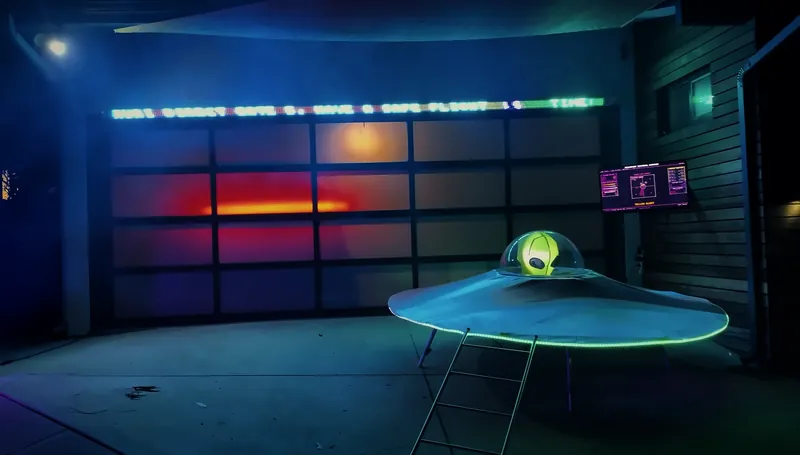
How I built it · Passenger edition
Some people put a skeleton on the lawn in October. We built a spaceport. A flying saucer, a departures board in lights over the garage, eyes in the garage door, a passport office and this website. I built it for fun, which is my explanation for most of it. Linux, my son, is my tiny flight engineer.
Want the wiring? Engineer's edition →
From a bare frame on the driveway to the maiden flight. Sound on: the spaceport intercom has announcements.
Flight record, SP1031
I · Halloween 2025
Last year we had a banner of lights over the garage and a smaller saucer on the driveway. When someone walked up, the banner wrote HUMAN DETECTED across the front of the house. It worked. It was not enough.
II · Early October
Before climbing anything, I built a pretend version of the lights on my computer. It runs the very same instructions as the real thing and draws them on the screen. Pilots learn in a flight simulator before they fly, and it turns out dads on ladders should too. It caught my mistakes from the comfort of a chair, which is where I prefer to catch them.
The same pretend version runs on my phone. That's how I found out the banner, after its nap, kept sleeping when it was supposed to wake up. Relatable. Fixed before it ever reached the garage.
III · 3 October
This website went up first, dressed as a 1964 airline ad for a spaceport that doesn't exist. Saturn by Saturday. The departures board always has a flight about to leave, because it runs on your own phone's clock. There are travel posters, a fare table, a crew, a cabin menu and travel advice for neighbors. Baggage allowance on every route: one towel.
The passport office opened the same day. More on that below.
IV · 6 October
Our garage door has twenty frosted windows, and with the lights on behind them it looks exactly like the side of a spaceship. That's where the name comes from: HULL/20. Plan A was to shine a film of a spaceship onto the door from inside.
On the 6th, like a rocket launch in bad weather, Plan A was scrubbed. The pictures I had made for it became the art on this website, and the door got a pair of eyes instead. I think the door came out ahead.
V · 12 October
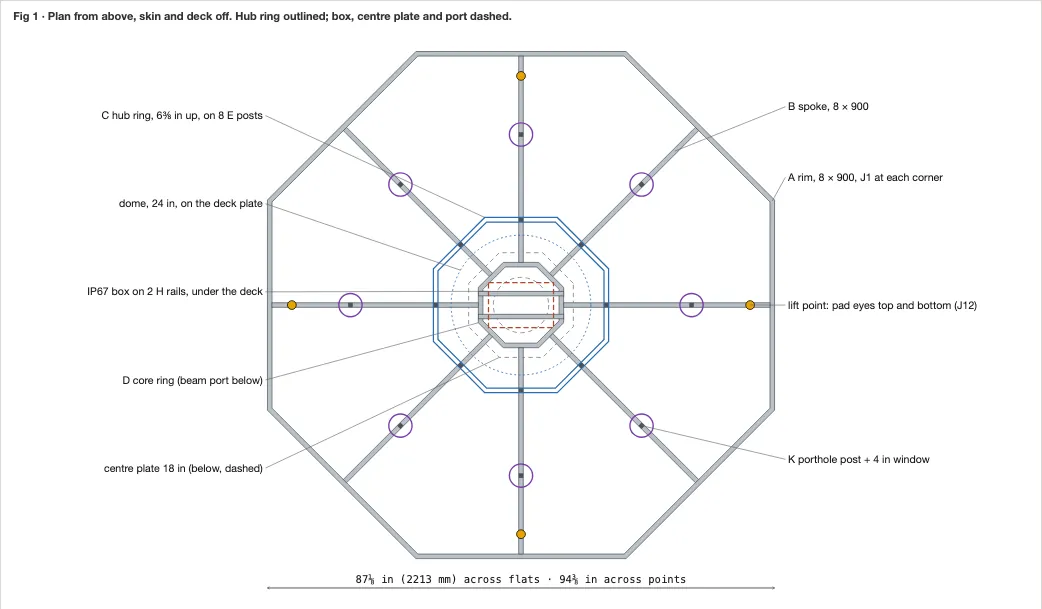
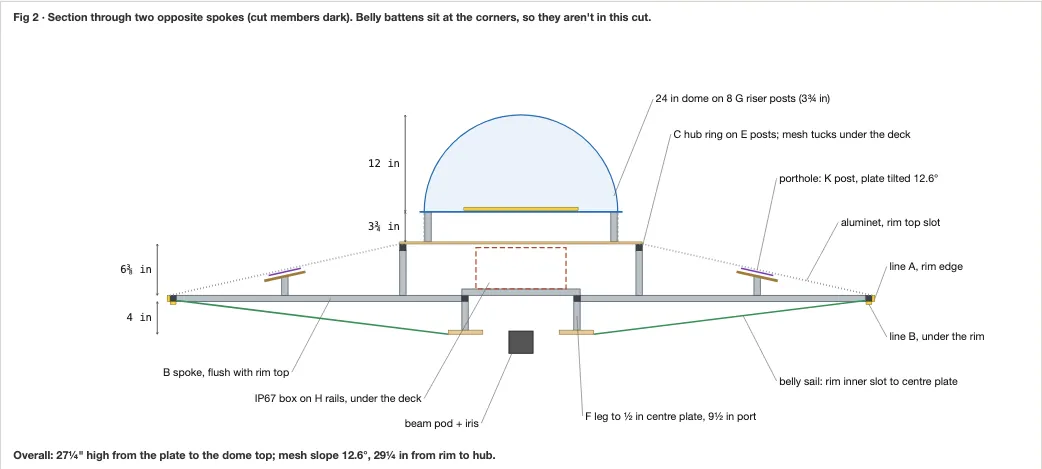
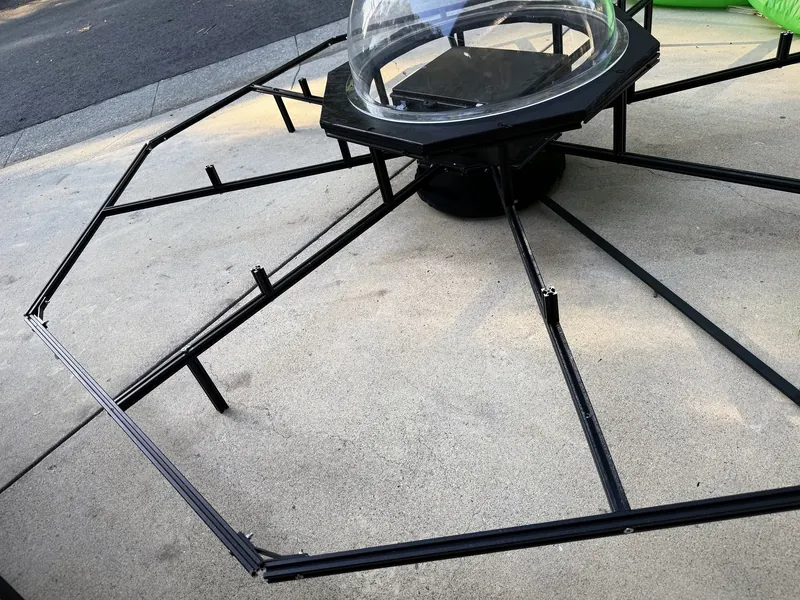
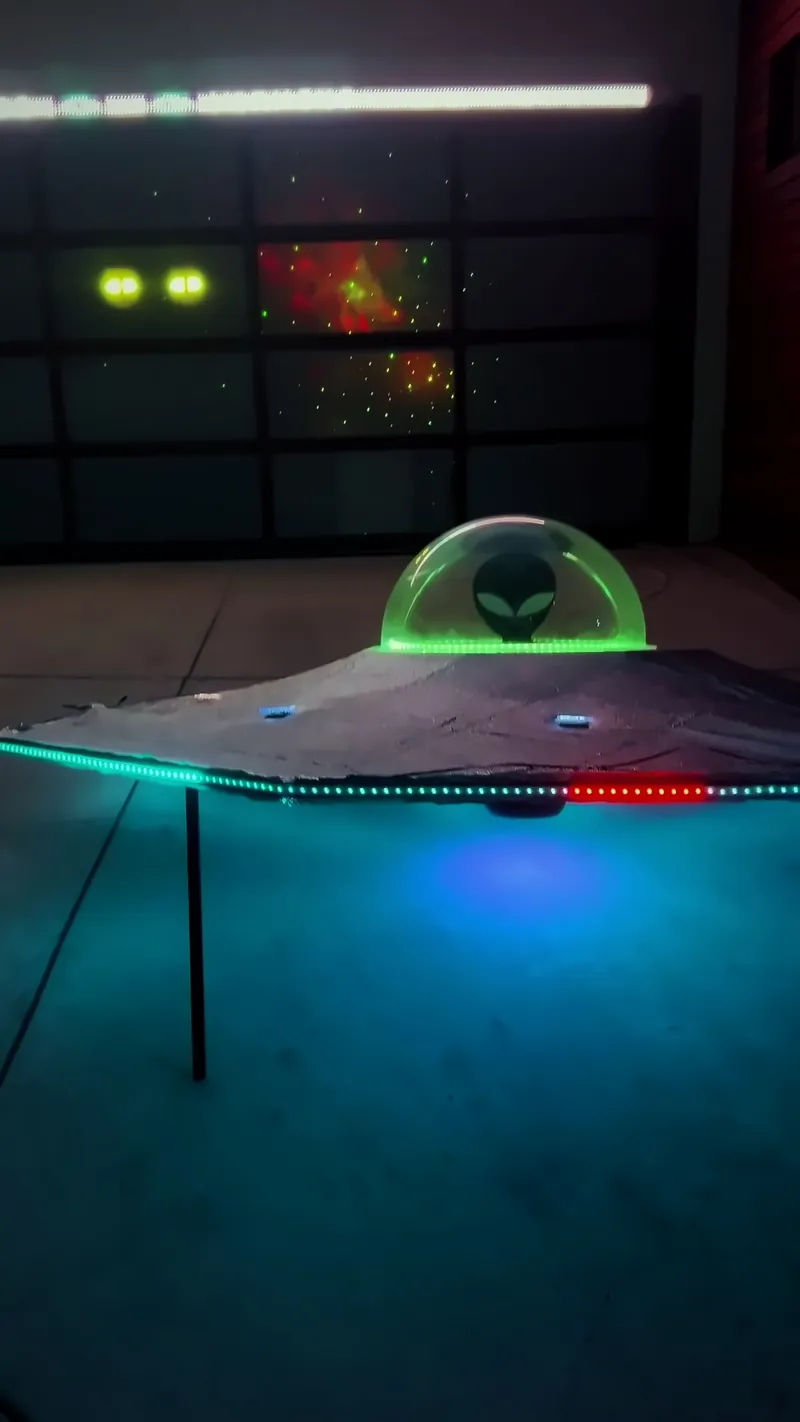
The saucer has eight sides and is a little over seven feet across. It's built from aluminum bars, like a very large construction set: a ring around the outside, eight spokes like a bicycle wheel, a small ring in the middle, and a clear bubble on top for the pilot.
Every piece meets at a square corner or the same easy angle, and the gentle slope of the top comes from the fabric skin pulled tight over it. I drew every piece before I cut anything. This is the sensible part of the story.
VI · Mid October
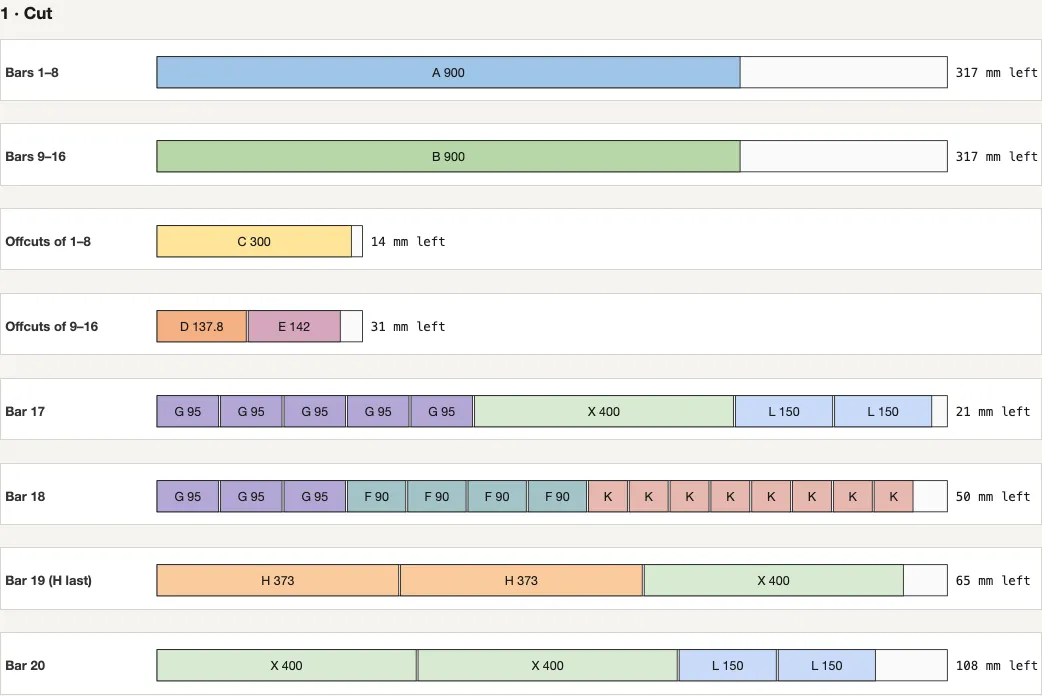
Twenty long aluminum bars, one saw, and a block clamped to the saw so every cut of a size comes out the same. It's like baking with cookie cutters: cut every cookie of one shape, then switch cutters, and label each one as it comes off.
Then a long afternoon of filing off sharp edges. Aluminum shavings get everywhere. Everywhere.
VII · 14 October
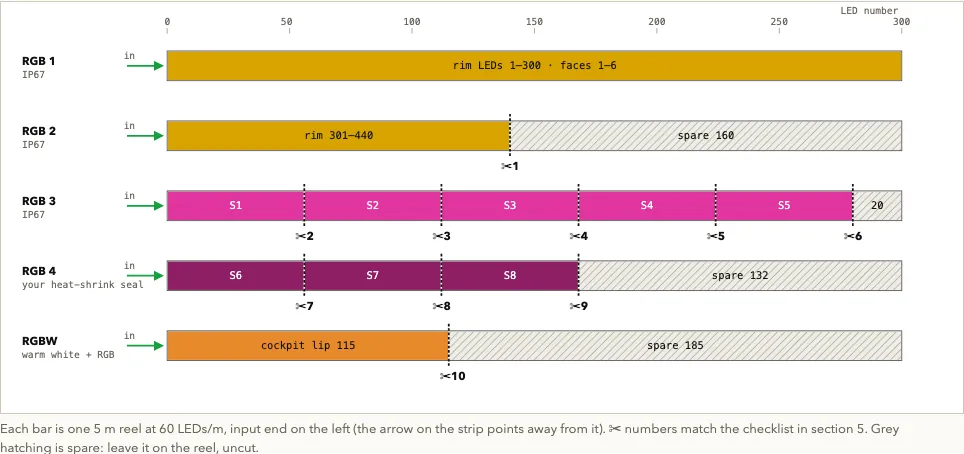
We didn't buy new lights. Last year's strings came out of the box, every one got tested, and the saucer was planned around what we had. One had a leak and got patched.
The drawing wanted 56 lights on each spoke. The strips come with 60 to a meter, so each spoke got 60, and I changed the saucer's instructions to match the ship instead of the drawing. Recycling, spaceport edition.
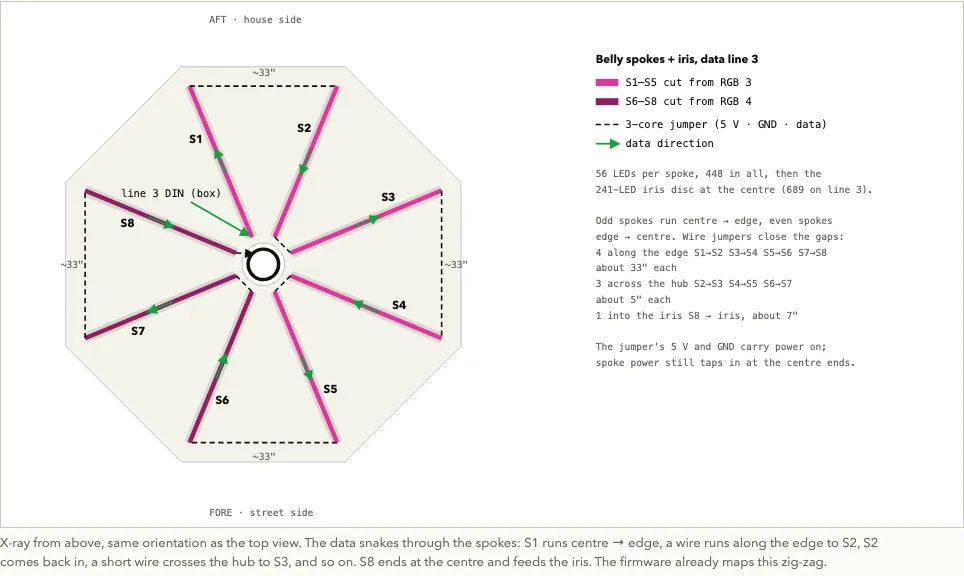
VIII · 15 October
At the gate, a screen held up by an inflatable alien who takes the job very seriously. That's where the passports got stamped, in person only. No stamping from the sofa. We run a serious spaceport.
The next day, high winds and dry air brought a red flag warning, so Gate 20 announced RED FLAG WARNING, FLIGHTS HELD. Passport control stayed open, because paperwork waits for no weather. Flights resumed at 8 pm on the 17th.
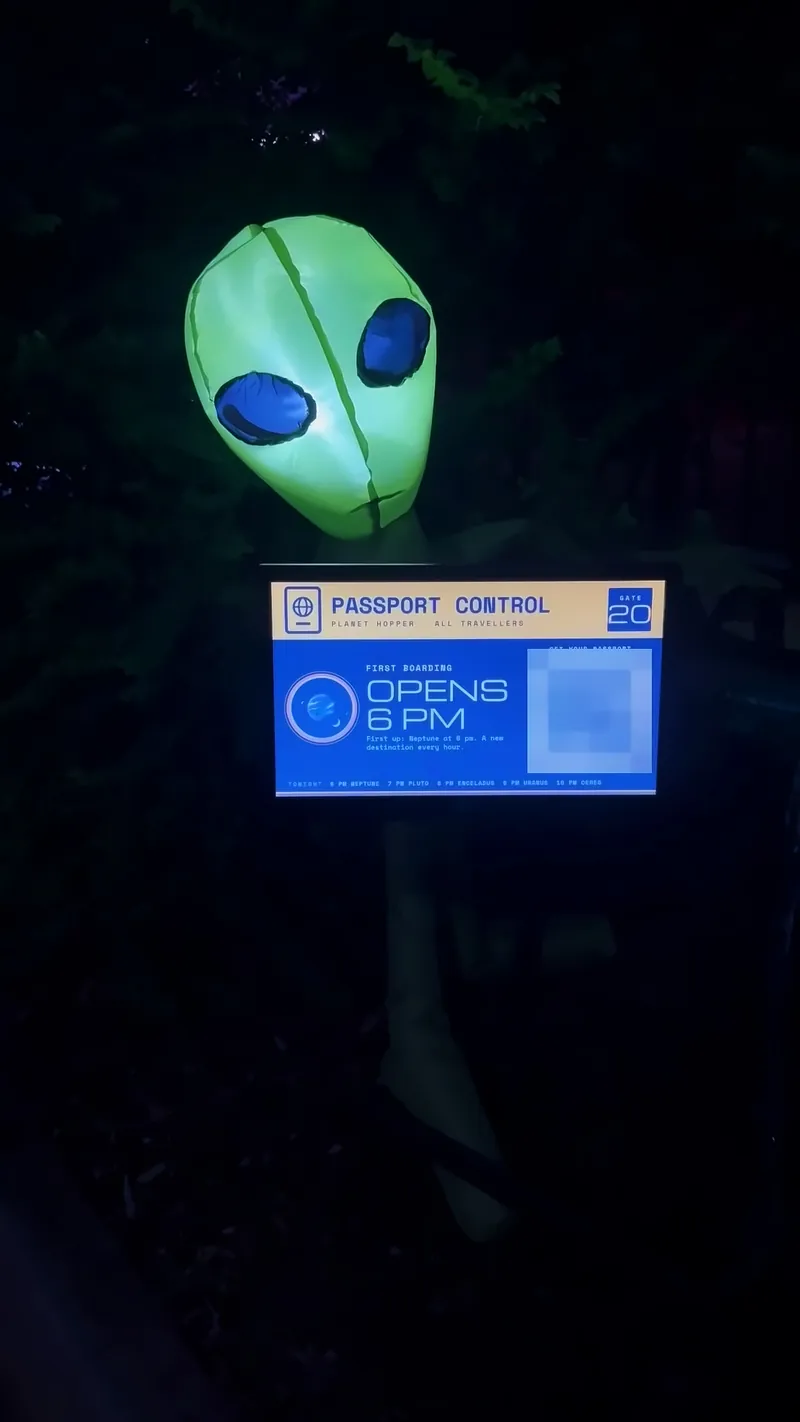
IX · 25 October
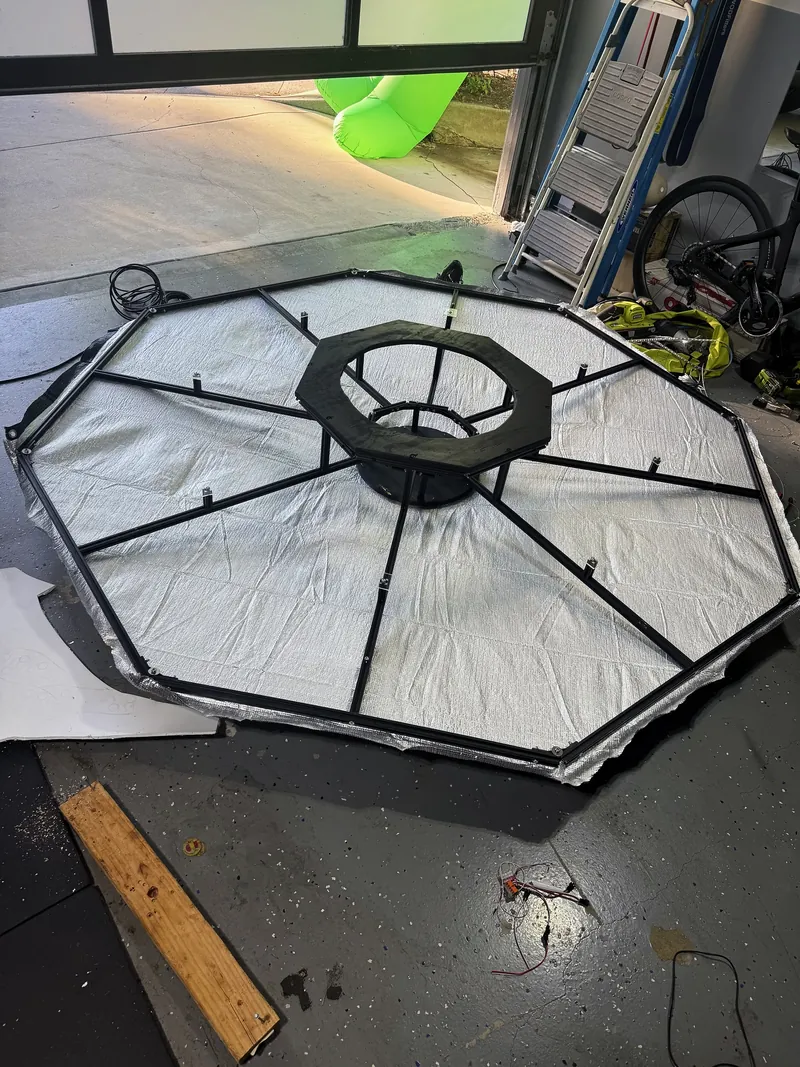
The frame came together on the driveway. Linux, my tiny flight engineer, did the final flight check on the dome.
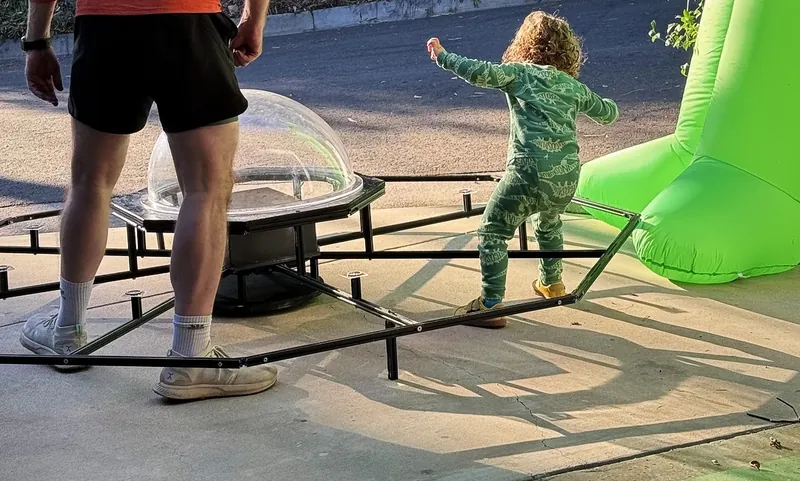
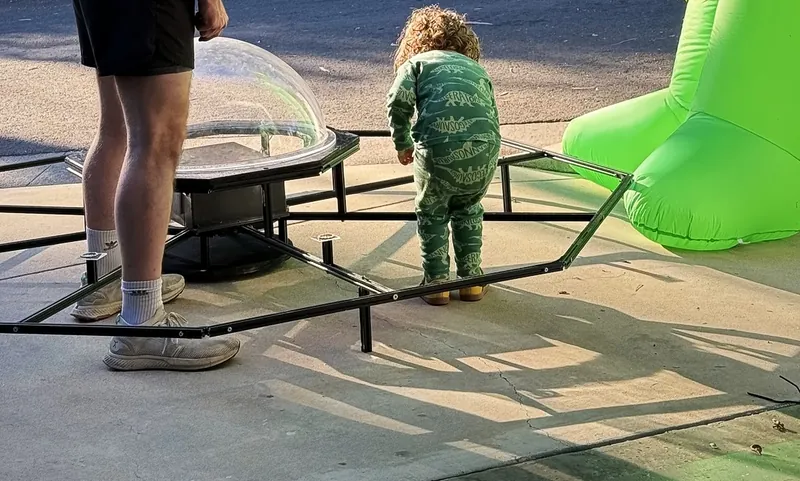
The skin went on the same week: silver shade cloth, the kind you'd stretch over a patio, pulled tight from the edge to the middle. That's what turns a bicycle wheel into a saucer.
X · 25 October
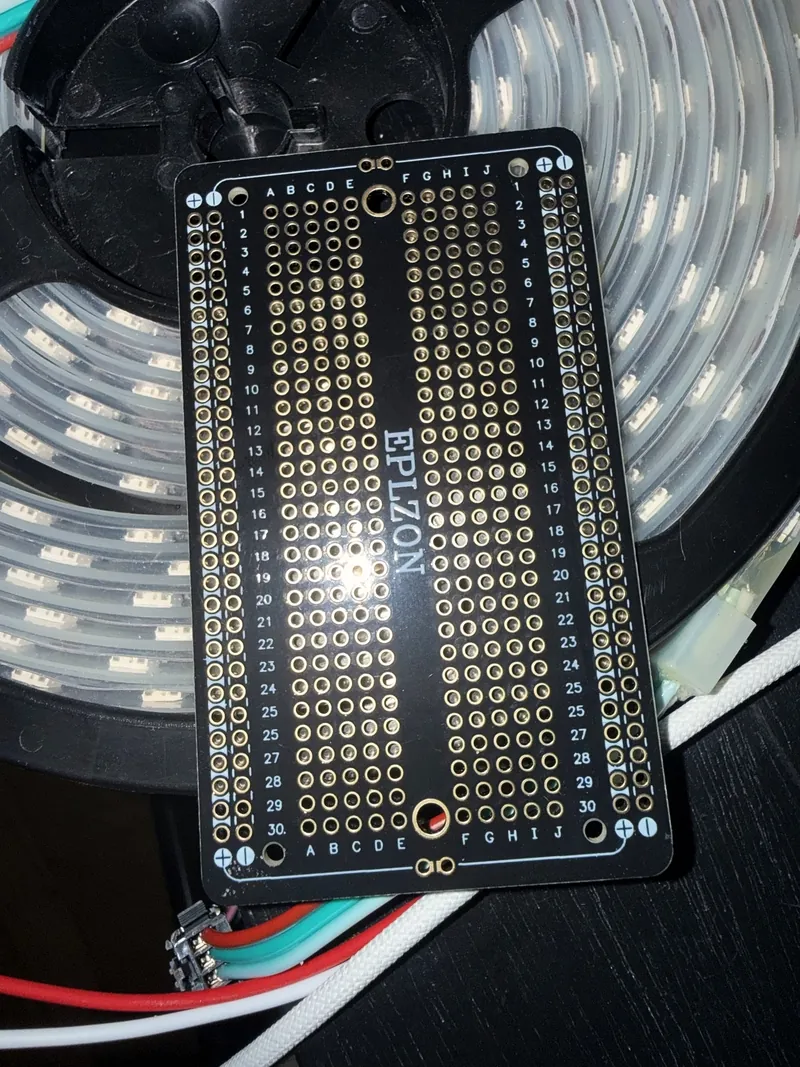
That evening I built the saucer's brain: a small computer about the size of a stick of gum, on a board I wired myself. Every wire soldered by hand, one at a time, thirty-five steps.
The fog machine and the extra beams came off the plan the same day. Every part you leave out is a part that can't break at 8 pm with a line of kids watching.
On the first test, three of the four sets of lights came on. The outside ring stayed dark. I followed the wire with a meter until I found the one bad connection, fixed it, and everything lit.
XI · 26 October
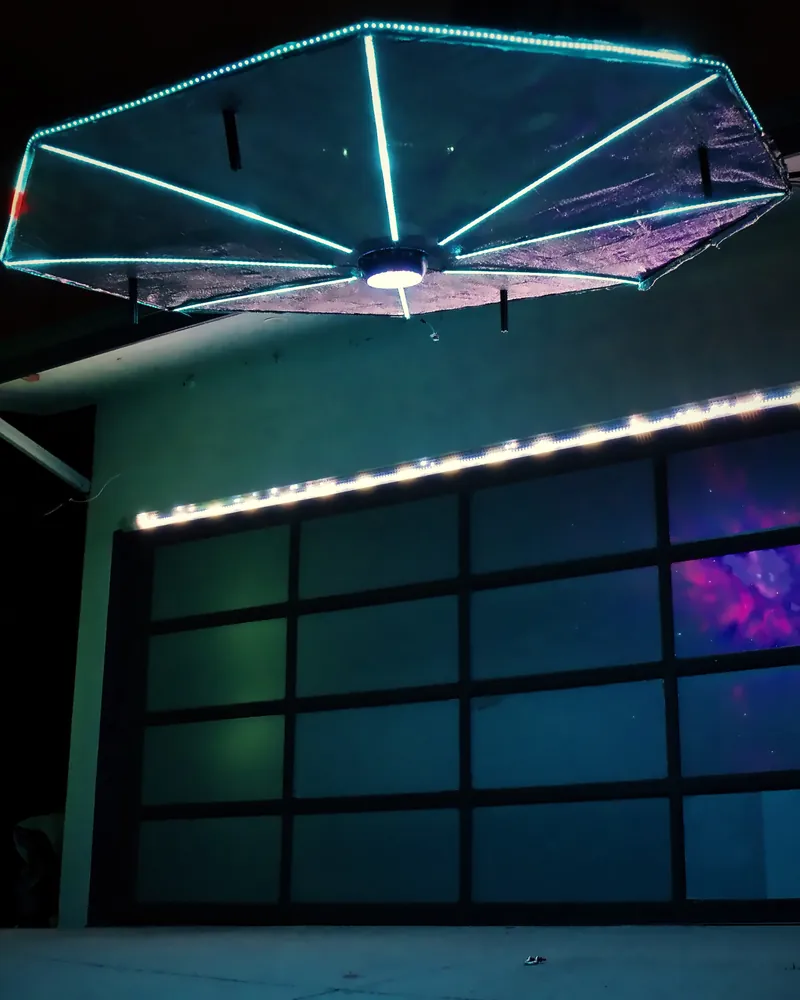
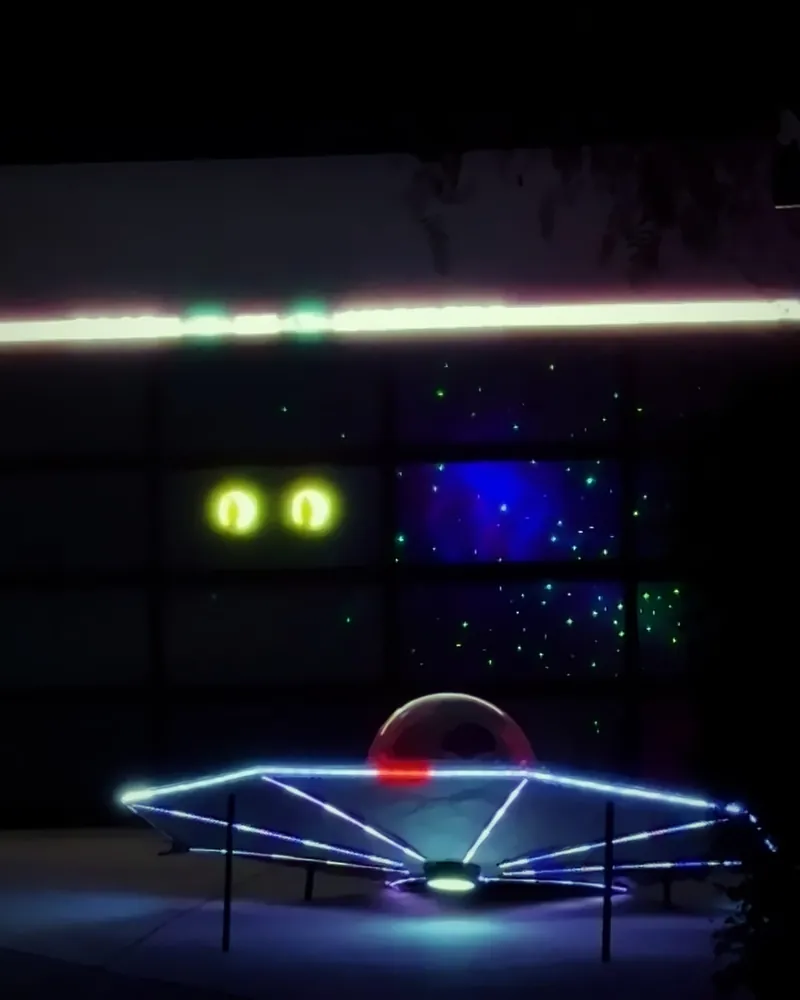
The next night it lit up in the garage: 1,406 lights. I counted. So did the saucer. We agree.
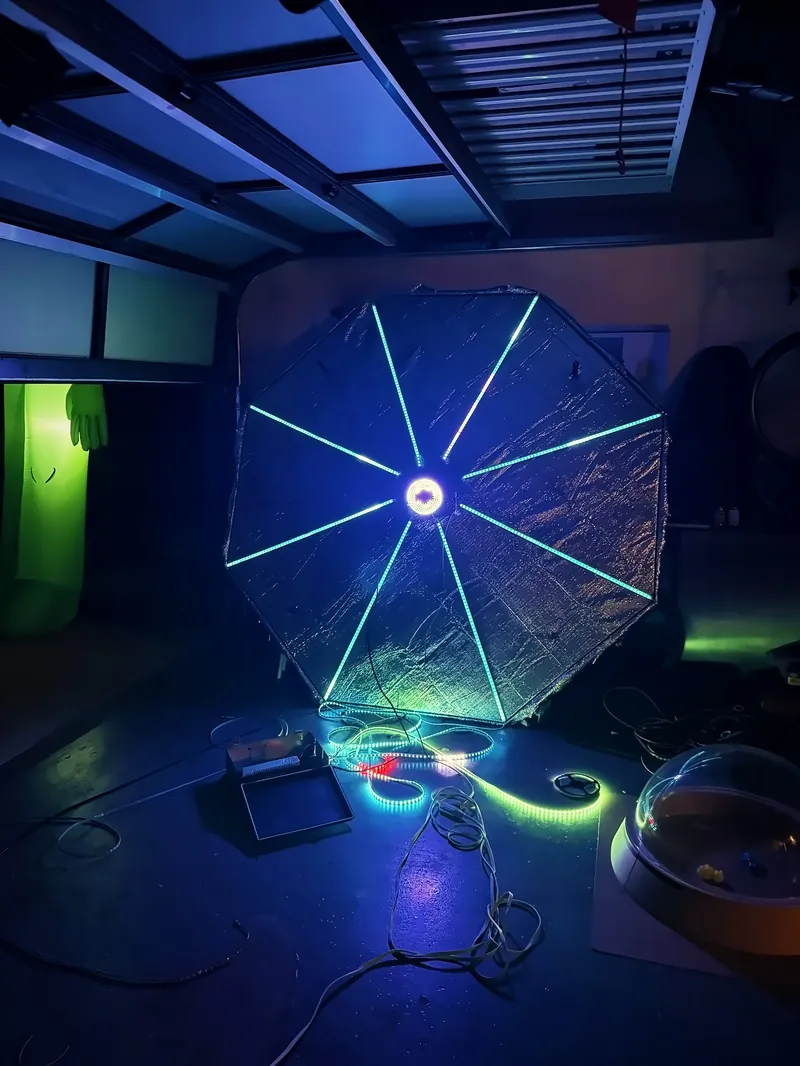
Most of the time it idles. The outer ring turns slowly, like an engine warming up, and now and then it does something on its own: a burst of chatter in the windows, a slow searching sweep, a little sputter. The big light in the middle of its belly is an eye. It looks around. It blinks.
Every few minutes it decides it has seen someone. The windows light up one after another, as if the crew rushed to that side to look. Then comes the abduction, about eleven seconds of it: blue light pours down the spokes into the middle, everything turns violet, there's a lift, a flash, a moment of darkness, and a ring of light rolls back out. Then it settles down as if nothing happened. It abducts nobody in particular. It keeps count anyway.
XII · 27 October
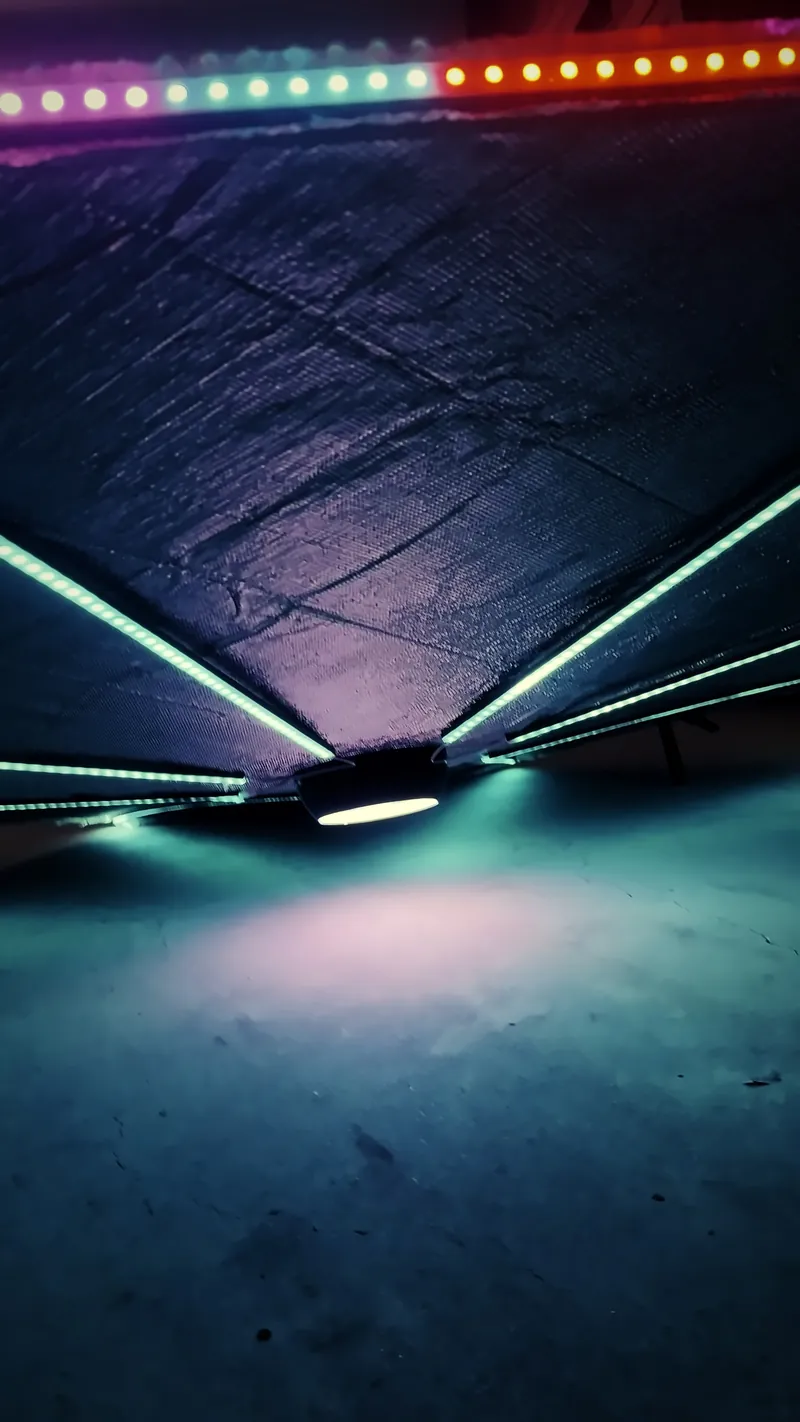
The saucer faces the street, so nothing on it flashes more than three times a second. That's the gentle limit that keeps flashing lights comfortable for people who are sensitive to them. My first version flickered like a dance floor, which is less "visitor from another world" and more "nightclub". Now everything fades instead of sparkling, and even the spinning ring has a speed limit.
I wrote a little program to watch the show for me. It played the show three hundred different ways and counted every flash, and it found one I couldn't see. Each of the eight round windows was blinking slowly on its own, but together they were taking turns so quickly that the whole ring pulsed twelve times a second. Think of eight people each clapping slowly, but in turn, so fast it sounds like one very fast clap.
A little math fixed it: now the windows pass the light from one to the next so smoothly that the total brightness never changes, like a relay where the baton never stops moving. It still looks like it's spinning. It just stopped shouting.
XIII · 29 October, morning
The saucer gets its updates over Wi-Fi. Out in the driveway, wrapped in aluminum, that's like trying to make a phone call from inside a baking tray: eleven updates in a row gave up halfway. So now updates go in by cable, the old-fashioned way. In space, no one can hear your Wi-Fi.
XIV · All October
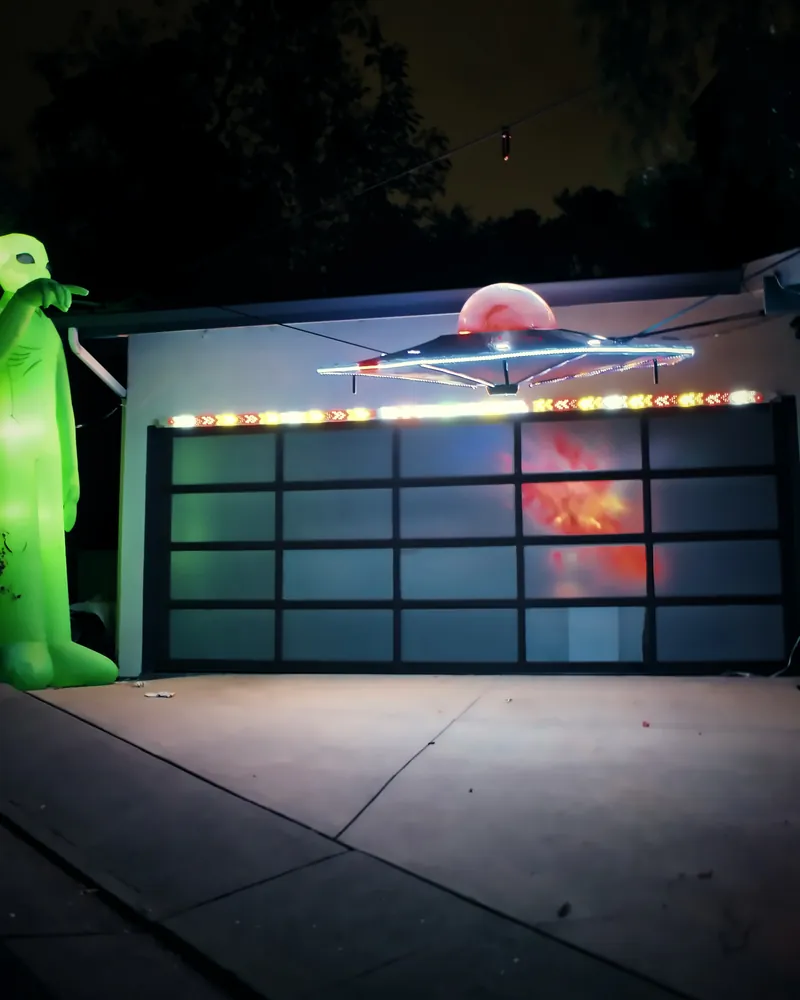
Behind two of the garage door windows are two panels of lights that make a pair of eyes. They blink. They look around. They know. Above them the banner runs its show all year, and in October it's a departures board, with flights to Titan and Europa. Late at night it sleeps as a pair of green eyes, which is cozy or unsettling depending on who's walking the dog.
XV · 29 October, night
The fleet's newest ship took its maiden flight. Acid rain or shine. It hung over the garage, lit from below, with the banner and the eyes behind it, and every few minutes it abducted nobody in particular.
XVI · 30 October
A spaceport without announcements is just a driveway with ambitions. So the port got a voice. Eight of them, in fact.
There's a gate agent, Captain Vrell, passport control, a purser, the adverts, paging, a robot called NAV-20 and the control tower, and each one has its own chime: a ding-dong for the gate, a bing-bong for the captain, three notes going up for passport control, a few robot blips for NAV-20 and a crackle of radio for the tower. Every voice was made on my own computer, then run through the sound of a 1960s terminal loudspeaker: thin, a little honky, with an echo off the far wall, the way airports sounded when flying still involved a hat.
Under them runs an original HULL/20 theme, built from nothing but math: a theremin, a walking bass, brushes on a snare and an electric piano, lounge style. Then thirty-six announcements. Pluto is still a planet here. Flights to Andromeda are cancelled, because Andromeda is coming to us. Lost and found is holding one towel. And abductions this evening are scheduled, not strobed.
To make sure every word came through the music, I had a computer listen to each announcement and write down what it heard. It heard "Hall 20" instead of HULL/20, so the gate agent now says it more carefully. It kept losing the s on Spaceways, so the band now steps back a little further and waits until the sentence is finished.
For the last nights of October, a small speaker at Gate 20 played a quiet bed of hall sounds and the saucer humming overhead, with an announcement every minute or two, until the port signed off: "Lights down at eleven." The film at the top of this page has the sound. Turn it up.
XVII · 29 October, night
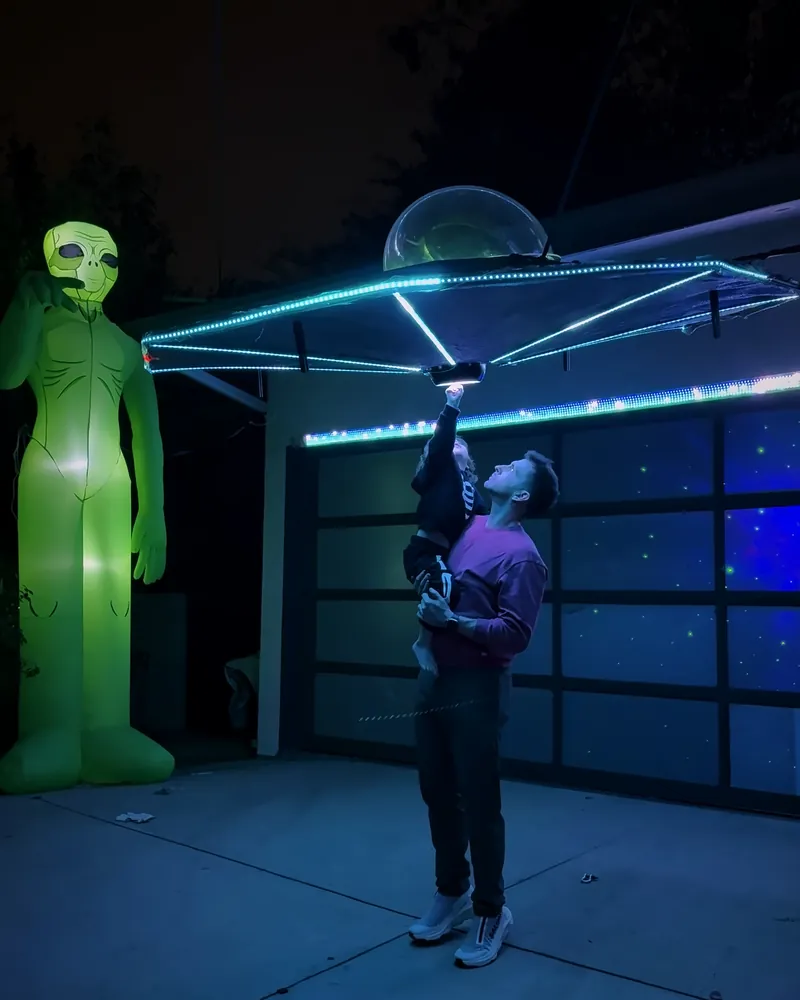
On the night of the maiden flight I held Linux up under the saucer and he reached up and touched it.
First contact.
He has since been abducted by the maker bug. Flight record closed. The ship is still up there.
Already planning next year
The ship flew through Halloween night in the rain without a flicker, and it isn't coming down: it stays up and flying through the holidays. Next year it gets a new skin: sixteen frosted panels that float on standoffs with a gap between each one, lit from inside.
Before cutting anything, I built the whole ship on the computer, to scale. You can take it apart, put it back together in build order, cut it in half or turn the lights off.
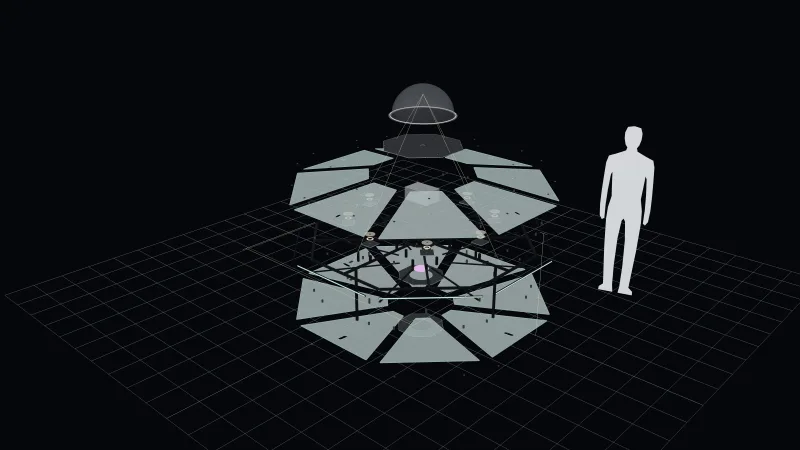
The part you can play with
The lights are what you see from the street. The part kids play with is on their phones.
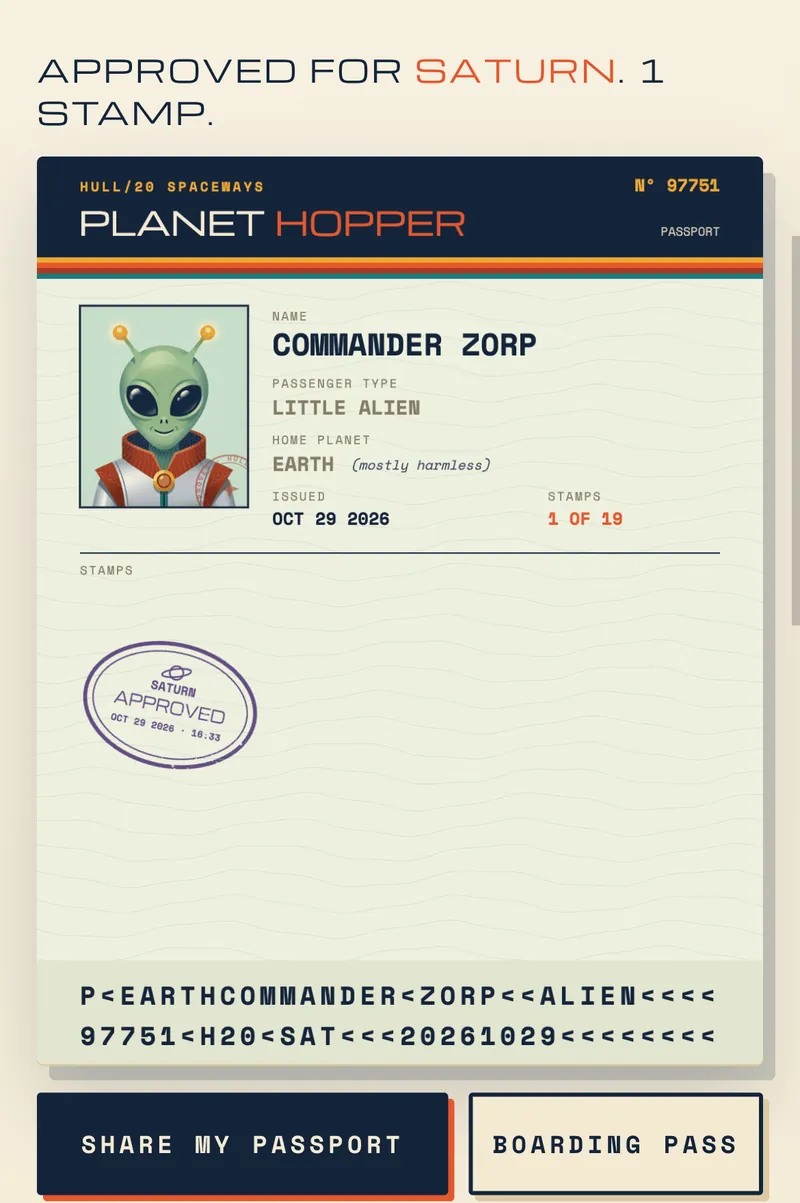
Planet Hopper is the passport office. Choose what kind of traveler you are ("All species welcome. Mostly.") and you get a passport that lives on your own phone, with nineteen destinations to collect. Your name is optional, and it's only ever printed on your own passport.
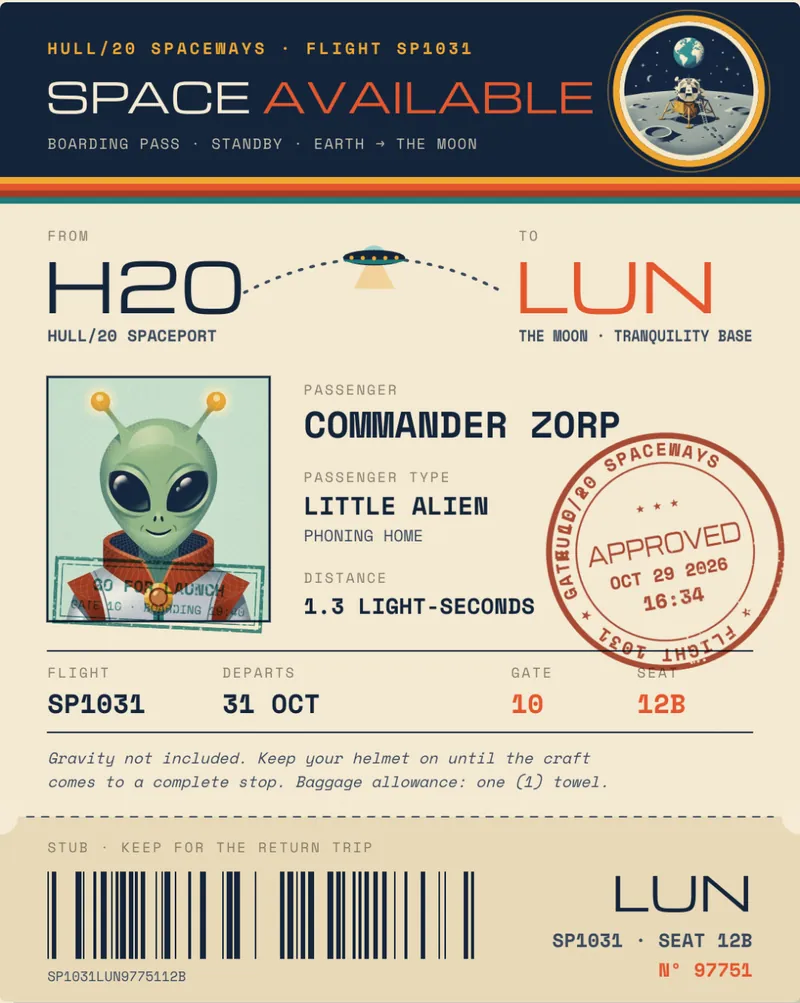
The stamps came from Gate 20. Every evening from the 15th to the 31st of October, its screen showed a code for that hour's planet. Scan it at the gate and the stamp went in your passport with the date and the time. A new planet every hour, so another night got you a different one. Six stamps made a Grand Tour.
Every stamp came with a boarding pass, Space Available on Flight SP1031, that goes into Apple Wallet with your name on it, right next to the real ones.
Visit the passport office →Gate 20 stamped passports every evening from 6 to 11, 15 to 31 October. The stamps stay in your passport, on your phone.
Next, a boarding pass you can actually hold.
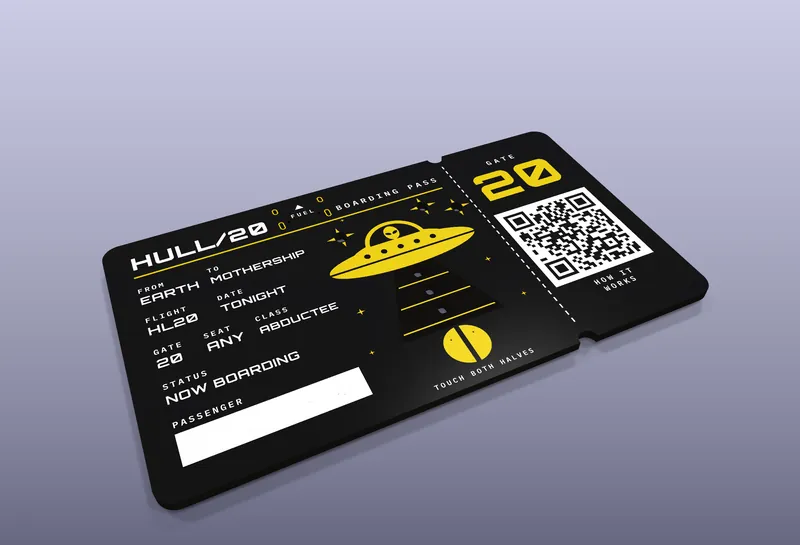
It's a little circuit board cut like a ticket: touch both halves and the saucer's beam lights up. We've ordered a hundred for Gate 20's passengers, which makes us either a souvenir shop or a very small airline.
For the engineers in the cabin
The same flight record with the access panels off: the cut list, the four data lines, the controller, the show's state machine, the flash math and the update that wouldn't land.
Engineer's edition →Now boarding