How I built it. Engineer's edition.
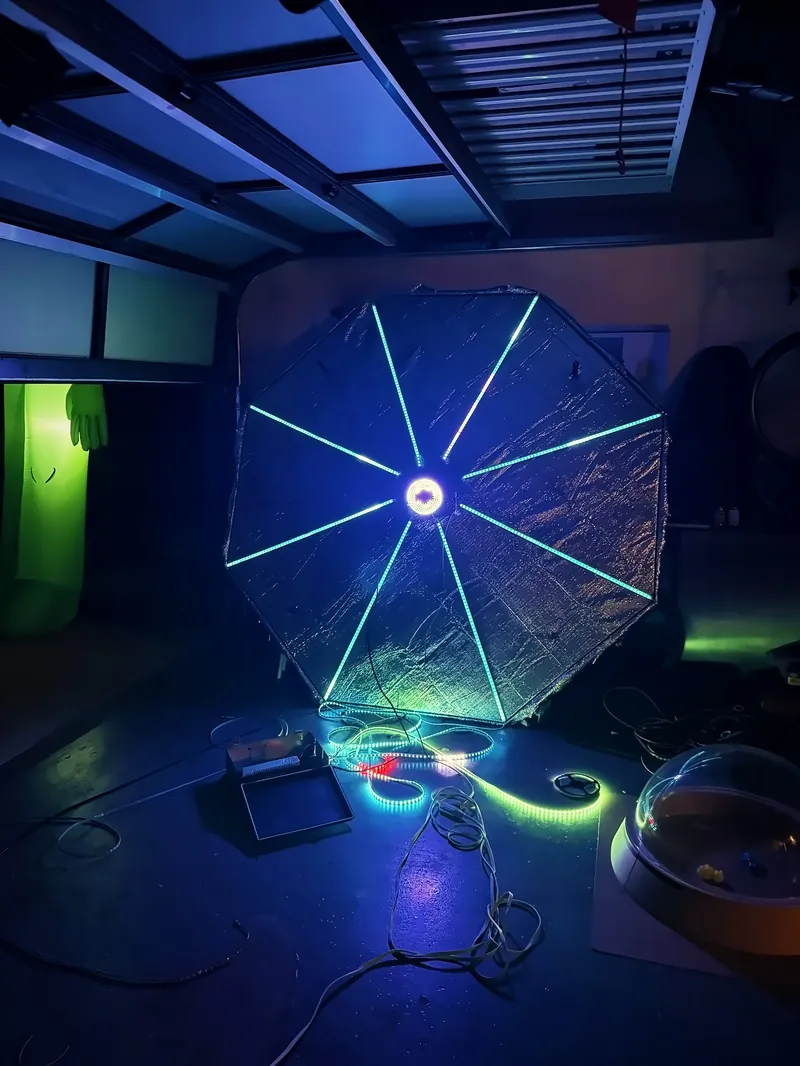
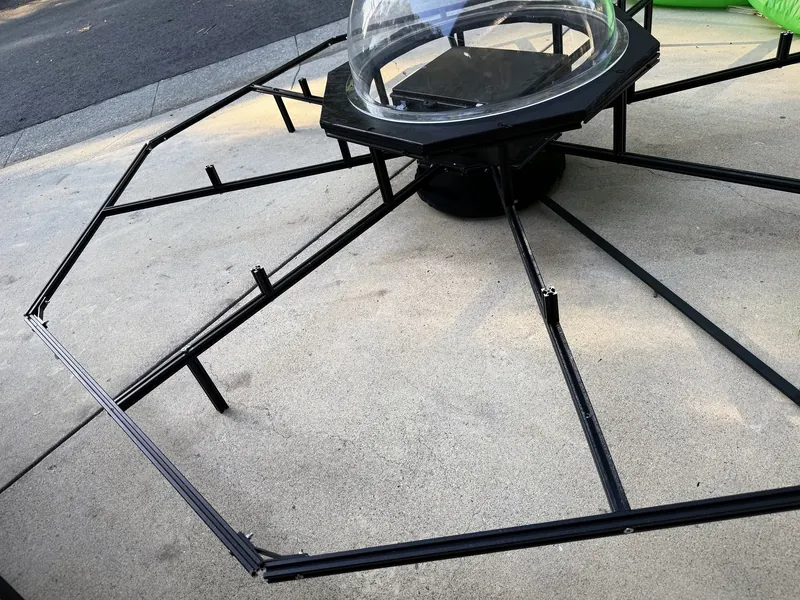
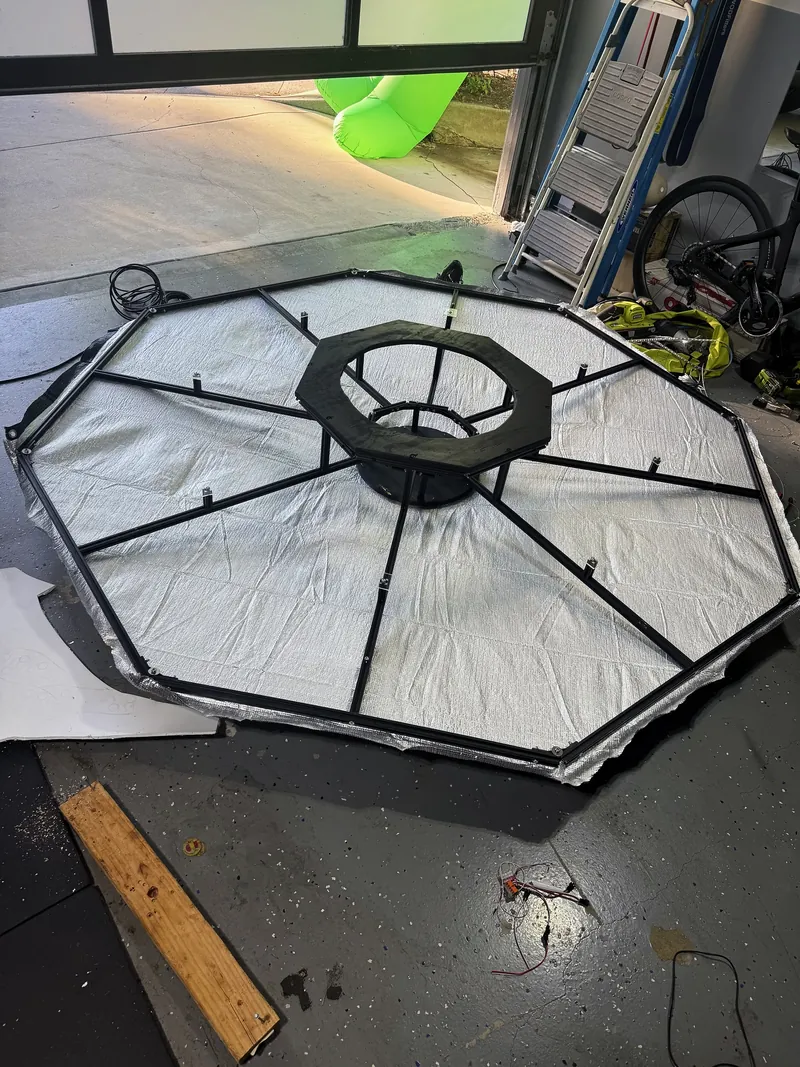
The saucer with the panels off
The same flight record as the Passenger edition, for makers: the cut list, the four data lines, the controller, the show's state machine, the flash math and the update that wouldn't land. Built for fun, by me and Linux, my tiny flight engineer. If you build one, send pictures.
Prefer the story? Passenger edition
Drawing package (frame, electrical, circuit boards): /build/drawings
| Revisions | ||||
|---|---|---|---|---|
| Zone | Rev | Description | Date | Approved |
| ALL | A | FIRST ISSUE: ENGINEER'S EDITION, SPLIT FROM THE BUILD STORY | 2026-10-30 | R. DIXON |
| SH 14 | B | SHEET XIII ADDED: THE SPACEPORT GETS A VOICE | 2026-10-30 | R. DIXON |
| ALL | C | NEW HULL/20 EMBLEM | 2026-10-30 | R. DIXON |
| — | D | FOOTER: NO COOKIES, NO TRACKERS, NO FORMS | 2026-10-30 | R. DIXON |
| ALL | E | REDRAWN AS A DRAWING SET. FRAME PLAN, SECTION AND ABDUCTION TIMING DRAWN FROM THE NUMBERS. DRAWING HULL-20-UFO-027 ADDED | 2026-11-01 | R. DIXON |
| Sheet | Ref | Title |
|---|---|---|
| 1 | This sheet: index, revisions, notes | |
| 2 | I | 3,418 LEDs, five craft |
| 3 | II | A simulator first |
| 4 | III | The frame |
| 5 | IV | Twenty bars and a stop block |
| 6 | V | Last year's lights, four lines |
| 7 | VI | Final flight check |
| 8 | VII | The controller |
| 9 | VIII | First light, and the show |
| 10 | IX | The supply and I have an understanding |
| 11 | X | No faster than three a second |
| 12 | XI | Eleven tries in the driveway |
| 13 | XII | How the yard talks |
| 14 | XIII | The spaceport gets a voice |
| 15 | XIV | What went into the saucer |
| 16 | XV | What boards next |
| 17 | XVI | Maiden flight |
| 1 | 027 | Skin, floating panels: parts list and notes |
| 2 | 027 | Cut parts |
| 3 | 027 | Plate, deck |
| 4 | 027 | Sections and details |
Notes
- Millimetres, with inches in brackets, unless a sheet says otherwise. Drawing HULL-20-UFO-027 is inch-first, like its cut files.
- Letters A to X are the frame pieces in the cut list, sheet 5. Find numbers 1 to 29 are the 2027 parts list, drawing HULL-20-UFO-027 sheet 1.
- Figures 1, 2 and 6 and every view on HULL-20-UFO-027 are drawn by a script from the numbers: the frame drawing, the cut files and the firmware's phase table. Dimensions govern; don't scale from the screen.
- Cut members are hatched, hidden edges dashed, removed parts in phantom (long, short, short), centre lines long and short.
- Unless otherwise specified
- DIMENSIONS IN MM [IN]
BUILD RECORD: AS BUILT,
NOT FOR MANUFACTURE
DO NOT SCALE DRAWING - Drawn
- R. DIXON
- 2026-11-01
- Checked
- R. DIXON
- 2026-11-01
- Approved
- R. DIXON
- 2026-11-01
- Owner
- HULL/20
SPACEWAYS - Document type
- BUILD RECORD
- Status
- RELEASED
- Units
- MM [IN]
- Projection
- THIRD ANGLE
PROJECTION - Title
- SAUCER, ACCESS PANELS OFF
- Size
- B
- Scale
- NTS
- Sheet
- 1 OF 17
- Dwg no.
- HULL-20-UFO-001
- Rev
- E
IThe fleet
3,418 LEDs, five craft
The saucer. An octagon of 2020 aluminum extrusion, 87⅛ inches across the flats, a clear 24-inch dome, an alien pilot who has never asked for a raise, and 1,406 LEDs on four data lines from an ESP32-S3 board.
The banner. 1,500 WS2812B LEDs, 300 x 5, serpentine, on a thumbnail-size ESP32-C6 board. A quiet show all year so the neighbors don't get suspicious; a departures board in October.
The garage eyes. Two 16x16 WS2812B panels behind two garage door windows, on their own ESP32-C6 board. They blink. They look around. They know.
Gate 20. A single-board computer and a 15.6-inch USB monitor, held up by an inflatable alien.
Mission control. A web page and a phone app I run the yard from: pin a scene, set the brightness, change the floodlights, feel powerful.
Banner 1,500; saucer 440 + 115 + 480 + 241 + 128 + 2 = 1,406; eyes 2 x 256 = 512.
- Unless otherwise specified
- DIMENSIONS IN MM [IN]
BUILD RECORD: AS BUILT,
NOT FOR MANUFACTURE
DO NOT SCALE DRAWING - Drawn
- R. DIXON
- 2026-10-30
- Checked
- R. DIXON
- 2026-10-30
- Approved
- R. DIXON
- 2026-10-30
- Owner
- HULL/20
SPACEWAYS - Document type
- BUILD RECORD
- Status
- RELEASED
- Units
- —
- Projection
- THIRD ANGLE
PROJECTION - Title
- FLEET, GENERAL ARRANGEMENT
- Size
- B
- Scale
- NTS
- Sheet
- 2 OF 17
- Dwg no.
- HULL-20-UFO-001
- Rev
- E
IIBefore the ladder
A simulator first
Before touching the banner again I built a desktop simulator that compiles the real firmware engine against a stub of FastLED and draws the strip in a browser. It models the wire time too. A WS2812B bit is 1.25 µs, so 24 bits is 30 µs per LED, and 1,500 LEDs on one data line is 45 ms plus the latch: about 21 frames a second, flat out. Better to learn that from a chair than from a ladder.
The banner's engine runs in three places: on the board, in the simulator and in the phone app's preview. The phone preview caught a real bug before it reached the wall: after waking up at night, the autopilot stayed asleep. Relatable.
The saucer's show went the other way round. I wrote it first as pure functions in JavaScript, in a 3D browser sim of the saucer, then ported it line for line to C++ for the Nano ESP32 and checked the two against each other pixel by pixel. The sim is where the look got decided. The port is where it got real.
- Unless otherwise specified
- DIMENSIONS IN MM [IN]
BUILD RECORD: AS BUILT,
NOT FOR MANUFACTURE
DO NOT SCALE DRAWING - Drawn
- R. DIXON
- 2026-10-30
- Checked
- R. DIXON
- 2026-10-30
- Approved
- R. DIXON
- 2026-10-30
- Owner
- HULL/20
SPACEWAYS - Document type
- BUILD RECORD
- Status
- RELEASED
- Units
- —
- Projection
- THIRD ANGLE
PROJECTION - Title
- SIMULATOR, FIRMWARE ENGINE
- Size
- B
- Scale
- NTS
- Sheet
- 3 OF 17
- Dwg no.
- HULL-20-UFO-001
- Rev
- E
III12 October
The frame
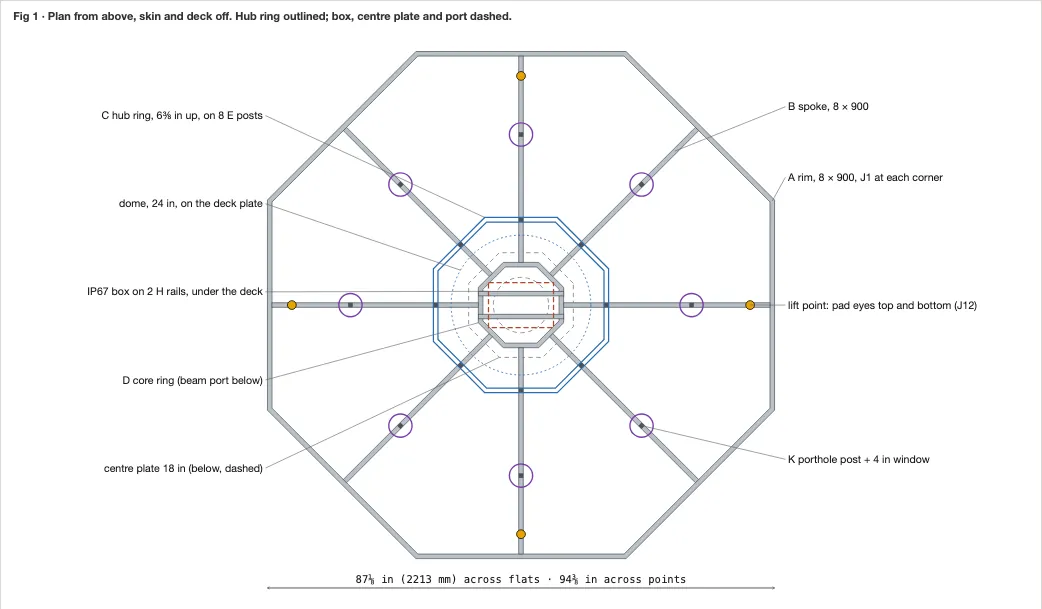
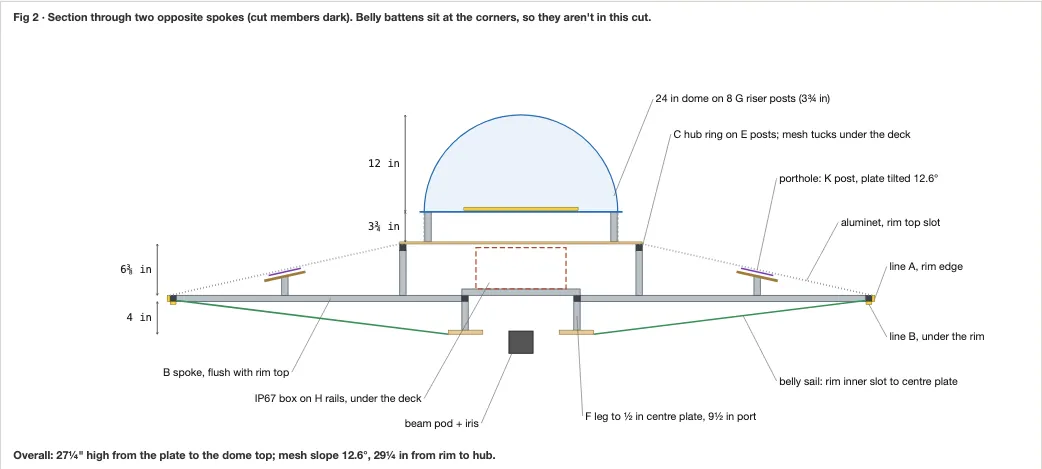
2020 T-slot: eight rim bars (A) in an octagon, eight spokes (B) to a hub ring (C) that stands 6⅜ inches up on eight posts (E), and a small core ring (D) at the center. 87⅛ inches (2,213 mm) across the flats, 94⅜ across the points.
There are no sloped joints. Everything meets square or at 135 degrees, with corner brackets at the rim, and the slope of the top comes from the skin pulled tight from the rim to the hub. Flat rings and straight spokes are stiffer than hinges, there's nothing to set by eye, and it's cheaper. Under the deck, an IP67 box sits on two rails across the core ring; the dome sits on the deck plate. Four of the spokes carry pad eyes top and bottom as lift points, and holes for the legs it stands on when it's landed.
I drew all of it before I cut anything. This is the sensible part of the story.
- Unless otherwise specified
- DIMENSIONS IN MM [IN]
BUILD RECORD: AS BUILT,
NOT FOR MANUFACTURE
DO NOT SCALE DRAWING - Drawn
- R. DIXON
- 2026-10-12
- Checked
- R. DIXON
- 2026-10-12
- Approved
- R. DIXON
- 2026-10-12
- Owner
- HULL/20
SPACEWAYS - Document type
- BUILD RECORD
- Status
- RELEASED
- Units
- MM [IN]
- Projection
- THIRD ANGLE
PROJECTION - Title
- FRAME, OCTAGON, 2020 T-SLOT
- Size
- B
- Scale
- NTS
- Sheet
- 4 OF 17
- Dwg no.
- HULL-20-UFO-001
- Rev
- E
IVMid October
Twenty bars and a stop block
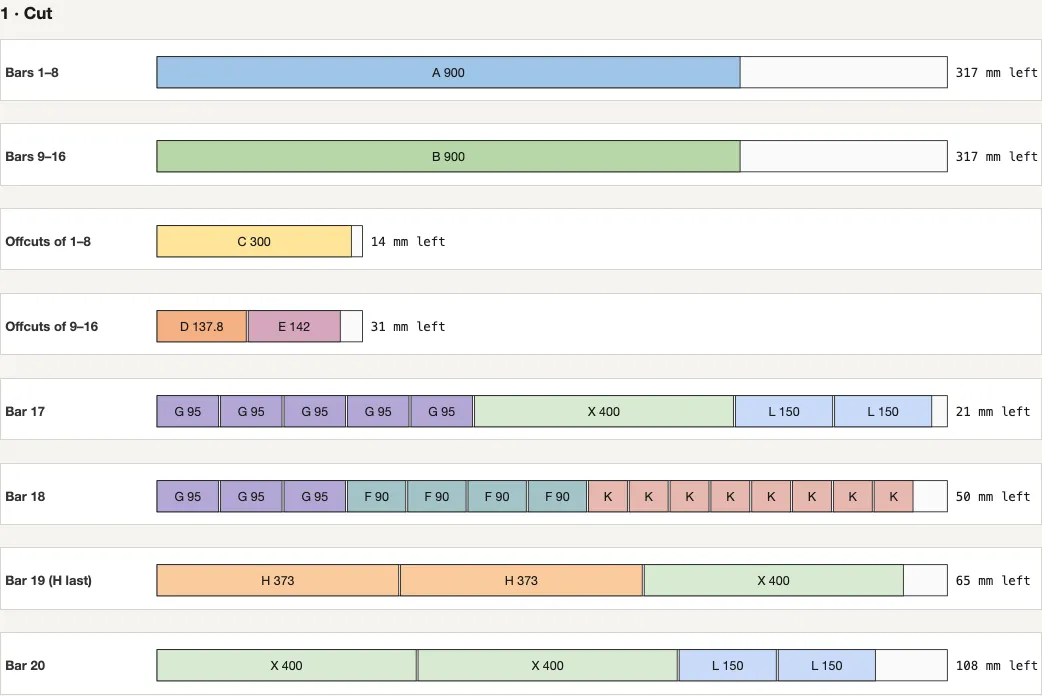
Twenty bars of 1,220 mm extrusion, a 3 mm kerf, square cuts only. At the saw, one stop block setting per letter: cut every piece of that letter, then move the block, and tape a label on everything as it comes off. Matching lengths within a letter matter more than the exact number.
Then 88 ends tapped M6, 25 mm deep (every B, E, F, G, K, L and X, both ends), 6.5 mm clearance holes on the center line with a drill guide, and 5.5 mm bracket holes marked through the brackets. And a great deal of deburring. Aluminum chips get everywhere. Everywhere.
| Item | Piece | Qty | Length | Cut from |
|---|---|---|---|---|
| A | rim | 8 | 900 mm (35⅜") | bars 1 to 8 |
| B | spoke | 8 | 900 mm (35⅜") | bars 9 to 16 |
| C | hub ring | 8 | 300 mm (11¾") | offcuts of A |
| D | core ring | 8 | 137.8 mm (5⅜") | offcuts of B |
| E | hub post | 8 | 142 mm (5⅝") | offcuts of B |
| F | plate leg | 4 | 90 mm (3½") | bar 18 |
| G | riser post | 8 | 95 mm (3¾") | bars 17, 18 |
| H | box rail | 2 | 373 mm (14⅝") | bar 19, cut last |
| K | porthole post | 8 | 60 mm (2⅜") | bar 18 |
| L | leg post | 4 | 150 mm (5⅞") | bars 17, 20 |
| X | leg extension | 4 | 400 mm (15¾") | bars 17, 19, 20 |
- Unless otherwise specified
- DIMENSIONS IN MM [IN]
BUILD RECORD: AS BUILT,
NOT FOR MANUFACTURE
DO NOT SCALE DRAWING - Drawn
- R. DIXON
- 2026-10 MID
- Checked
- R. DIXON
- 2026-10 MID
- Approved
- R. DIXON
- 2026-10 MID
- Owner
- HULL/20
SPACEWAYS - Document type
- BUILD RECORD
- Status
- RELEASED
- Units
- MM [IN]
- Projection
- THIRD ANGLE
PROJECTION - Title
- CUT LIST, 20 BARS OF 1220
- Size
- B
- Scale
- NTS
- Sheet
- 5 OF 17
- Dwg no.
- HULL-20-UFO-001
- Rev
- E
V14 October
Last year's lights, four lines
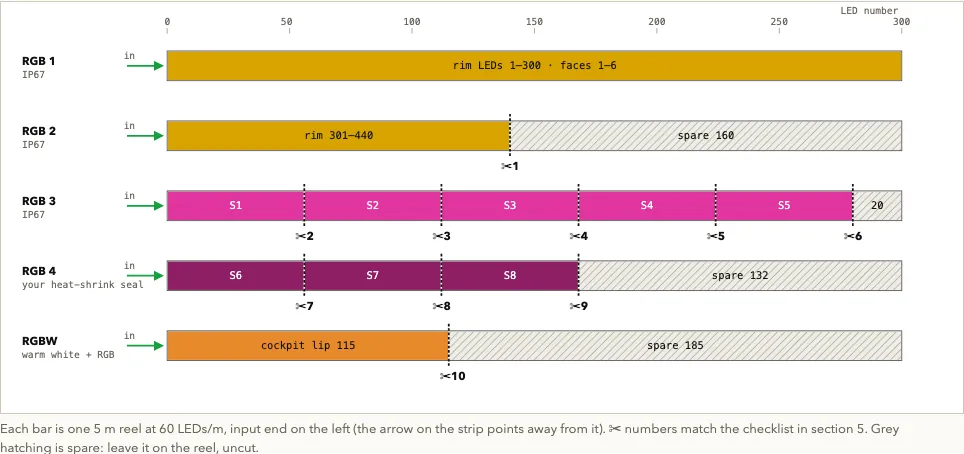
No new LEDs. I had four 5 m strips of 60/m RGB and a warm white RGBW one from last year, so each got a bench test and every cut was planned around what was on the reel. One had a bad seal and got resealed with heat shrink. Recycling, spaceport edition.
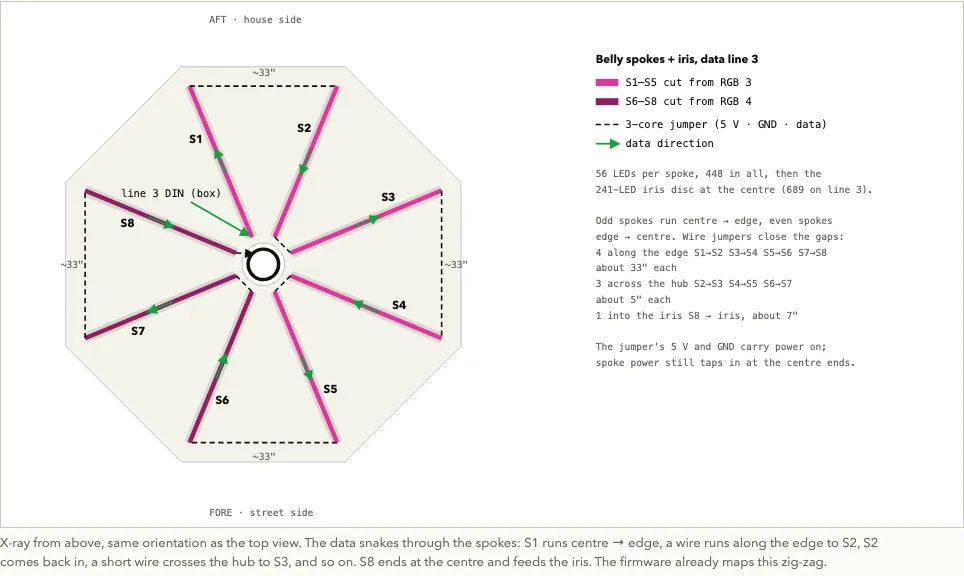
The plan called for 56 LEDs per spoke. A meter is 60, so the spokes got 60 and the firmware was changed to match the ship rather than the drawing. The rim is one strip running all the way around through eight aluminum channels with milky diffusers. The spokes are cut pieces joined with short wires, so one data line snakes out along a spoke, across to the next, and back in, then carries on into the big light in the belly.
| Line | Runs | LEDs | Wire time |
|---|---|---|---|
| 1 | Rim, one strip through all eight channels | 440 RGB | 13.2 ms |
| 2 | Dome lip, warm white | 115 RGBW | 4.6 ms (32 bits each) |
| 3 | Eight spokes (8 x 60), then the belly disc (241, nine rings) | 721 RGB | 21.6 ms |
| 4 | Eight portholes (8 x 16), then the pilot's two eyes | 130 RGB | 3.9 ms |
Line 3 is the long one. Putting the belly light at the end of the spokes saved a cable to the center and cost nothing that shows.
- Unless otherwise specified
- DIMENSIONS IN MM [IN]
BUILD RECORD: AS BUILT,
NOT FOR MANUFACTURE
DO NOT SCALE DRAWING - Drawn
- R. DIXON
- 2026-10-14
- Checked
- BENCH TEST
- 2026-10-14
- Approved
- R. DIXON
- 2026-10-14
- Owner
- HULL/20
SPACEWAYS - Document type
- BUILD RECORD
- Status
- RELEASED
- Units
- LEDS
- Projection
- THIRD ANGLE
PROJECTION - Title
- LED LINES, FOUR DATA RUNS
- Size
- B
- Scale
- NTS
- Sheet
- 6 OF 17
- Dwg no.
- HULL-20-UFO-001
- Rev
- E
VI25 October
Final flight check
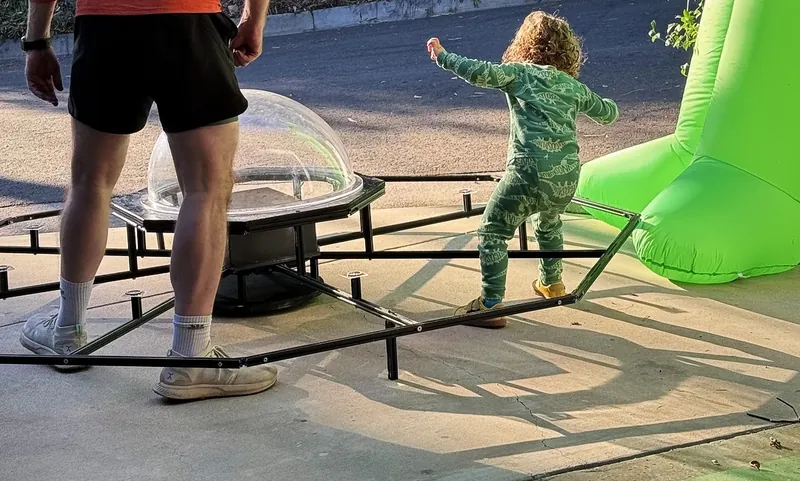
The frame came together on the driveway. Linux, my tiny flight engineer, did the final flight check on the dome. The skin went on the same week: Aluminet, an aluminized shade cloth, top and belly, pulled tight from the rim to the hub.
- Unless otherwise specified
- DIMENSIONS IN MM [IN]
BUILD RECORD: AS BUILT,
NOT FOR MANUFACTURE
DO NOT SCALE DRAWING - Drawn
- R. DIXON
- 2026-10-25
- Checked
- LINUX
- 2026-10-25
- Approved
- R. DIXON
- 2026-10-25
- Owner
- HULL/20
SPACEWAYS - Document type
- BUILD RECORD
- Status
- RELEASED
- Units
- —
- Projection
- THIRD ANGLE
PROJECTION - Title
- FRAME, FINAL FLIGHT CHECK
- Size
- B
- Scale
- NTS
- Sheet
- 7 OF 17
- Dwg no.
- HULL-20-UFO-001
- Rev
- E
VII25 October
The controller
The fog machine and the beam pods (with their 12 V supply and MOSFET) came off the manifest the same day, and so did the screw terminals. Every part you take out is a part that can't fail at 8 pm with a line of kids watching.
It's two stacked protoboards. Board A holds the Nano ESP32 on headers and a 74AHCT125 in a socket (so the chip is never soldered), with a 0.1 µF ceramic beside it. Board B is where the outside world lands: four 330 Ω series resistors, one per data line, a 100 µF can across the 5 V input, and solder points for four two-wire cables (DATA plus a GND reference) and the 5 V feed from the power box's fuse. Six short wires join the two boards. No screw terminals: every wire soldered straight into its hole, one wire per step, 35 steps.
Why the level shifter: the ESP32 drives 3.3 V logic, and a WS2812B powered at 5 V wants 0.7 x VDD, 3.5 V, for a clean high. Sometimes it reads 3.3 V anyway. Sometimes is not a word you want in a flight record. The 74AHCT125 has TTL input thresholds, so 3.3 V is a solid high, and its outputs swing the full 5 V. The 330 Ω resistors take the ringing off the edges on the way down the cables.
Pixel power doesn't go through the controller at all. The power box feeds each run through its own inline fuse, with a 100 µF capacitor at each strip start. The controller only sends data, plus a ground for the data to be measured against.
The bench test runs test firmware that lights all four lines at once, each in its own color (rim green, dome blue, spokes purple, portholes cyan), with a short test strip moved from cable to cable. Three of the four lit the first time. The rim stayed dark. I went down the chain with a meter, found it at the first resistor, and then everything lit.
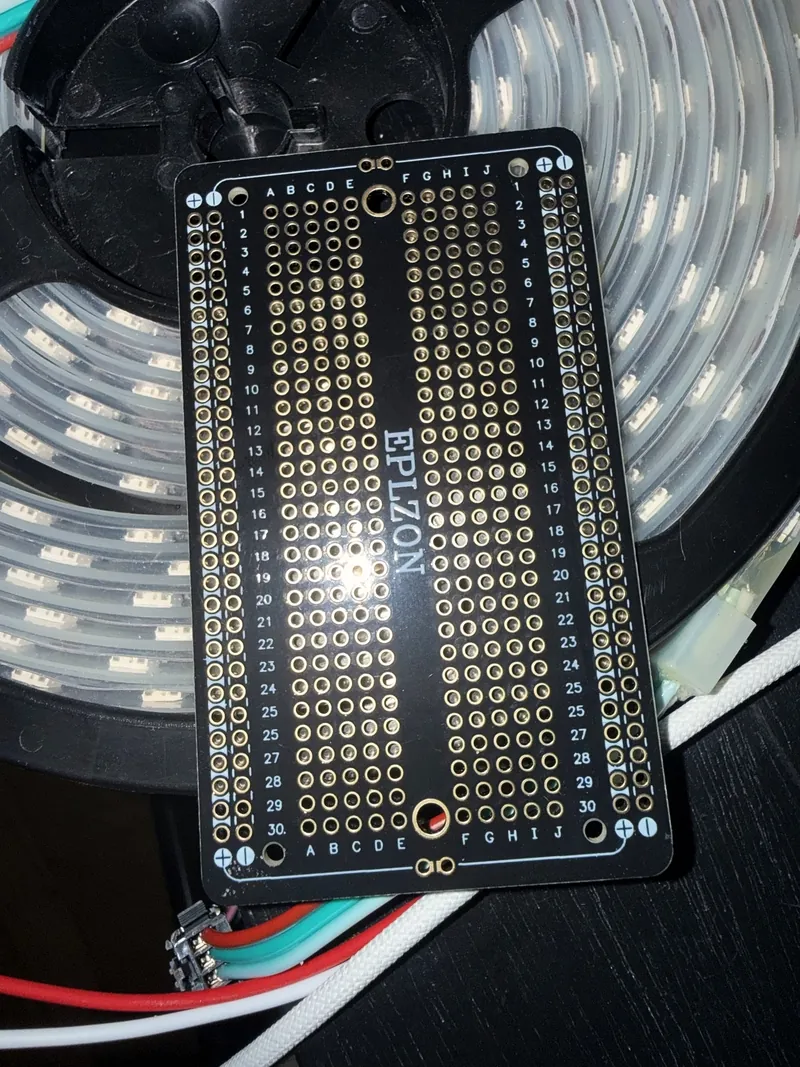
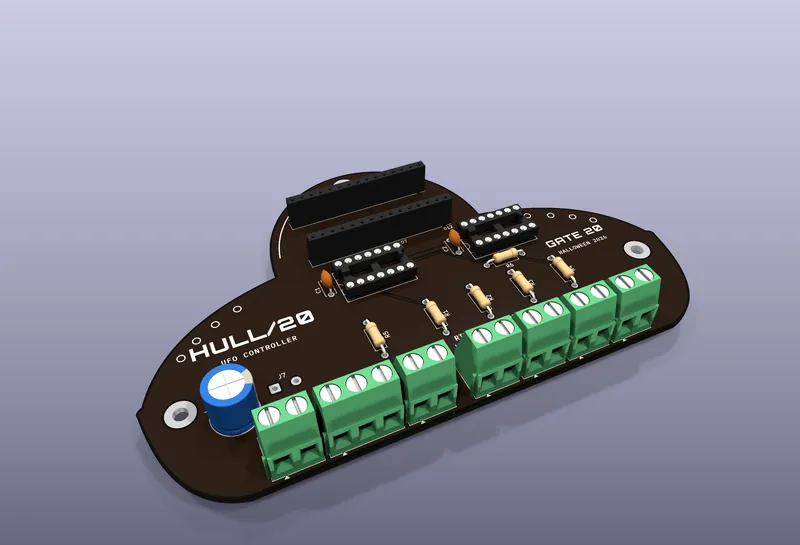
I also drew the controller as a proper circuit board, HULL/20 on the silkscreen and all. That drawing is from 17 October, before the screw terminals came off, and it stayed a drawing. The one flying is the hand-wired stack.
- Unless otherwise specified
- DIMENSIONS IN MM [IN]
BUILD RECORD: AS BUILT,
NOT FOR MANUFACTURE
DO NOT SCALE DRAWING - Drawn
- R. DIXON
- 2026-10-25
- Checked
- BENCH TEST
- 2026-10-25
- Approved
- R. DIXON
- 2026-10-25
- Owner
- HULL/20
SPACEWAYS - Document type
- BUILD RECORD
- Status
- RELEASED
- Units
- —
- Projection
- THIRD ANGLE
PROJECTION - Title
- CONTROLLER, TWO-BOARD STACK
- Size
- B
- Scale
- NTS
- Sheet
- 8 OF 17
- Dwg no.
- HULL-20-UFO-001
- Rev
- E
VIII26 October
First light, and the show
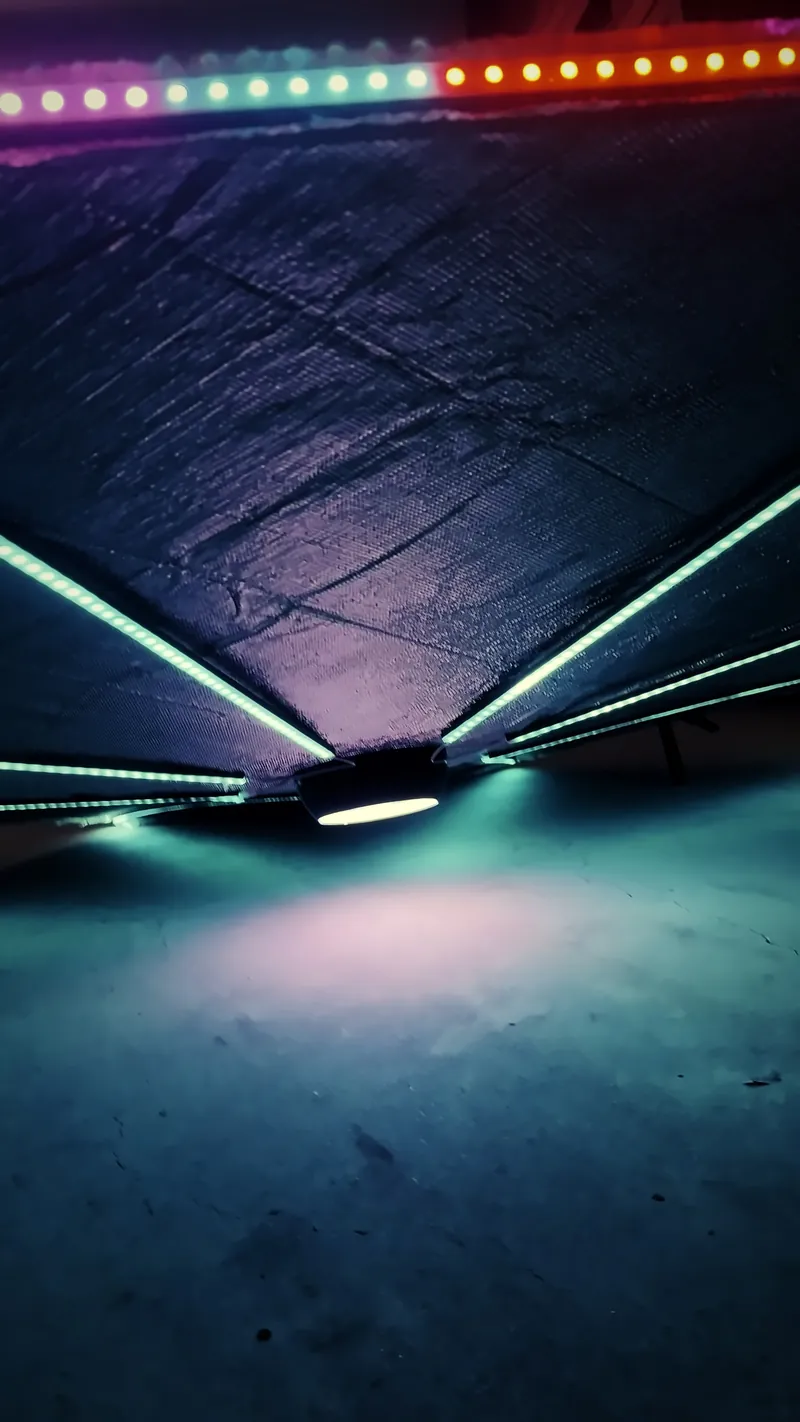
The next night it lit up in the garage: 1,406 LEDs. I counted. So did the firmware. We agree.
The show is a small state machine, the same one in the sim and on the board:
| Mode | How long | What it does |
|---|---|---|
| Idle | 150 to 240 s, random | The rim turns like a turbine. Rare events: comms (4.6 s), search (6 s), sputter (6.6 s) |
| Approach | 3.5 s | The portholes light in sequence from one side, like the crew rushing to the window |
| Abduction | 11.2 s | Charge 2.0 s, beam 4.5 s, lift 8.0 s, flash 9.6 s, black 9.75 s, release 10.05 s, end 11.2 s |
| Cooldown | 3.0 s | Back to idle |
The abduction, in order: the portholes lock on, cyan fills the spokes toward the white center, violet at full speed, a lift of soft white on the rim, a flash, a moment of black, and a ring of light runs back out. Abductions are scheduled, not strobed. The saucer keeps a passenger count, incremented at the flash. Nobody has been taken. The count is a formality.
The phase table and the rings of the belly light, as they are in the firmware:
static const float PH_CHARGE = 2.0f, PH_BEAM = 4.5f, PH_LIFT = 8.0f,
  PH_FLASH = 9.6f, PH_BLACK = 9.75f, PH_RELEASE = 10.05f, PH_END = 11.2f;
static const uint8_t IRIS_RINGS[9] =
  { 1, 8, 12, 16, 24, 32, 40, 48, 60 };   // 241 LEDs
A few details I'm fond of. The turbine has inertia: a first-order lag that's quick to spin up (0.9 s) and slow to spin down (2.2 s), capped at 2 turns a second. Idle events come 20 to 60 seconds apart and only start once the turbine has calmed down, because comets plus an event went over the flash limit. The big light in the belly is drawn as an eye: a pupil, a gaze that drifts on slow noise, and a blink every 5 to 14 seconds in which the rings close from the outside in. On lock-on the gaze stops drifting and snaps. There's an input for a camera to say where the person is; there's no camera on the saucer, so it snaps at whoever it imagines. And the show clock wraps around in a quiet moment, so float precision doesn't wander over a long night.
- Unless otherwise specified
- DIMENSIONS IN MM [IN]
BUILD RECORD: AS BUILT,
NOT FOR MANUFACTURE
DO NOT SCALE DRAWING - Drawn
- R. DIXON
- 2026-10-26
- Checked
- FIRMWARE
- 2026-10-26
- Approved
- R. DIXON
- 2026-10-26
- Owner
- HULL/20
SPACEWAYS - Document type
- BUILD RECORD
- Status
- RELEASED
- Units
- S
- Projection
- THIRD ANGLE
PROJECTION - Title
- SHOW, STATE MACHINE
- Size
- B
- Scale
- NTS
- Sheet
- 9 OF 17
- Dwg no.
- HULL-20-UFO-001
- Rev
- E
IXPower
The supply and I have an understanding
Full white on 1,406 LEDs is roughly 87 A on paper at 20 mA a channel (1,291 RGB at 60 mA, 115 RGBW at 80 mA). The supply is a 350 W enclosed supply, 5 V and 60 A, and I'd rather not ask it for everything, so every frame is summed before it goes out and scaled down if it would go over 30 A. From the simulator; the firmware does the same thing, with less commentary:
// ~20 mA per channel at 255
export function frameAmps(buf) { let s = 0;
  for (let k = 0; k < buf.length; k++) s += buf[k];
  return (s / 255) * 0.020; }
export function limitFrame(saucerBuf, cap, limitA) {
  const raw = frameAmps(saucerBuf) * cap;
  const k = raw > limitA ? (cap * limitA) / raw : cap;
  return { scale: k, rawAmps: raw, amps: Math.min(raw, limitA) };
}- Unless otherwise specified
- DIMENSIONS IN MM [IN]
BUILD RECORD: AS BUILT,
NOT FOR MANUFACTURE
DO NOT SCALE DRAWING - Drawn
- R. DIXON
- 2026-10-30
- Checked
- R. DIXON
- 2026-10-30
- Approved
- R. DIXON
- 2026-10-30
- Owner
- HULL/20
SPACEWAYS - Document type
- BUILD RECORD
- Status
- RELEASED
- Units
- A
- Projection
- THIRD ANGLE
PROJECTION - Title
- POWER, 5 V 60 A SUPPLY
- Size
- B
- Scale
- NTS
- Sheet
- 10 OF 17
- Dwg no.
- HULL-20-UFO-001
- Rev
- E
X27 October
No faster than three a second
The saucer faces the street, so it holds one hard line: no part of it flashes more than 3 times a second, the usual photosensitive safety line. My first version flickered 16 to 30 times a second in places, which is less "visitor from another world" and more "nightclub". Every flicker now steps on one shared clock at 4 changes a second, sparkle became fades, and the turbine tops out at 2 turns a second.
I wrote a flash counter that renders the show at 64 frames a second, measures every rim face, porthole and spoke, and counts flashes in every one-second window, across 300 random seeds and every command the show accepts. It found one I couldn't see: during the charge, a bright comet ran around the eight portholes. Each window flashed slowly, but the ring as a whole pulsed 12 times a second.
The fix is a lobe of ((1 + cos φ) / 2)⁴, the porthole's brightness as a function of its angle from the sweep. Expand it and it's a polynomial of degree 4 in cos φ, so it has no harmonic above the 4th. Sum it over eight evenly spaced windows and every harmonic from the 1st to the 7th cancels, which leaves only the constant: the ring's total brightness stays flat while the lobe goes round. It still looks like it's spinning. The math just stopped it from shouting. Now 0 of 300 seeds go over the line.
// one sweep at 1.5 a second. A cos^4 lobe has no harmonic above the 4th,
// so over 8 evenly spaced windows the ring's total stays constant.
float b = powf(0.5f + 0.5f * cosf(2 * (float)M_PI
  * (frac(st.t * 1.5f) - aw)), 4);
set(o, CYAN, 0.08f + 0.4f * sstep(PH_CHARGE, PH_BEAM, s));
add(o, lerpC(CYAN, HOT, sp), b);- Unless otherwise specified
- DIMENSIONS IN MM [IN]
BUILD RECORD: AS BUILT,
NOT FOR MANUFACTURE
DO NOT SCALE DRAWING - Drawn
- R. DIXON
- 2026-10-27
- Checked
- FLASH COUNTER
- 2026-10-27
- Approved
- R. DIXON
- 2026-10-27
- Owner
- HULL/20
SPACEWAYS - Document type
- BUILD RECORD
- Status
- RELEASED
- Units
- HZ
- Projection
- THIRD ANGLE
PROJECTION - Title
- FLASH LIMIT, 3 PER SECOND
- Size
- B
- Scale
- NTS
- Sheet
- 11 OF 17
- Dwg no.
- HULL-20-UFO-001
- Rev
- E
XI29 October, morning
Eleven tries in the driveway
The saucer takes updates over Wi-Fi with a password. In the driveway, inside an aluminum frame, an aluminum box and shade cloth, 11 tries in a row stopped partway, each at a different point. It looks like the board restarts mid-transfer. The one update that ever landed out there had USB power plugged in as well. So updates go over the cable now, and the current firmware turns the Wi-Fi modem's power saving off. In space, no one can hear your Wi-Fi.
Every update lands in the other of two flash slots, so the slot doesn't tell you what's running. Each build now prints its own build id on the serial line at boot, so I always know which version of me wrote the bug.
- Unless otherwise specified
- DIMENSIONS IN MM [IN]
BUILD RECORD: AS BUILT,
NOT FOR MANUFACTURE
DO NOT SCALE DRAWING - Drawn
- R. DIXON
- 2026-10-29
- Checked
- R. DIXON
- 2026-10-29
- Approved
- R. DIXON
- 2026-10-29
- Owner
- HULL/20
SPACEWAYS - Document type
- BUILD RECORD
- Status
- RELEASED
- Units
- —
- Projection
- THIRD ANGLE
PROJECTION - Title
- FIRMWARE UPDATES
- Size
- B
- Scale
- NTS
- Sheet
- 12 OF 17
- Dwg no.
- HULL-20-UFO-001
- Rev
- E
XIIThe yard
How the yard talks
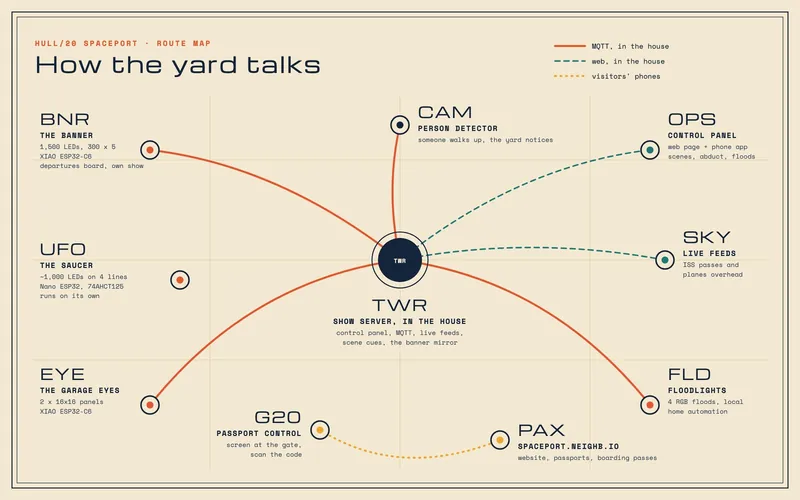
Every board runs its own show. If the Wi-Fi goes down, the saucer, the banner and the eyes carry on like professionals. A small server in the house sits on top: the control panel and the phone app talk to it, and it talks to the banner and the eyes through a message broker. It feeds the banner live data, like planes and ISS passes overhead, and it runs the four floodlights. A person detector on an outside camera tells the banner when someone walks by, and the banner answers with a soft glow that walks along with them. The saucer doesn't listen to the network at all yet. It runs its show and minds its own business, like a good saucer.
Gate 20 is a single-board computer running an airport departures loop. From 15 to 31 October, every evening from 6 to 11, it showed a code for that hour's planet, and scanning it put the stamp in a Planet Hopper passport on the visitor's own phone. Six stamps made a Grand Tour. The red flag on the 16th switched it to RED FLAG WARNING, FLIGHTS HELD until 8 pm on the 17th; passport control stayed open, because paperwork waits for no weather.
- Unless otherwise specified
- DIMENSIONS IN MM [IN]
BUILD RECORD: AS BUILT,
NOT FOR MANUFACTURE
DO NOT SCALE DRAWING - Drawn
- R. DIXON
- 2026-10-30
- Checked
- R. DIXON
- 2026-10-30
- Approved
- R. DIXON
- 2026-10-30
- Owner
- HULL/20
SPACEWAYS - Document type
- BUILD RECORD
- Status
- RELEASED
- Units
- —
- Projection
- THIRD ANGLE
PROJECTION - Title
- YARD NETWORK
- Size
- B
- Scale
- NTS
- Sheet
- 13 OF 17
- Dwg no.
- HULL-20-UFO-001
- Rev
- E
XIII30 October
The spaceport gets a voice
A spaceport without announcements is just a driveway with ambitions.
The theme. An original 27-second HULL/20 theme, synthesised from scratch in Python with numpy and scipy, no samples: a theremin lead, a walking upright bass, brushes, an FM electric piano and airline chimes, at 100 BPM and cut to the reel's beat grid. Three styles were on the table: lounge, abduction and surf-rocket. Lounge won. It's a spaceport, not a getaway.
The voices. Kokoro text-to-speech, run locally, one voice per role: gate agent, Captain Vrell, passport control, purser, adverts, paging, NAV-20 and the tower. NAV-20 gets ring modulation and a metallic comb filter; the tower is band-limited like a radio. Then every line goes through the same 1960s terminal PA: a narrow band, a horn honk and a slap-back echo off the far wall. Each role has its own chime: a ding-dong for the gate, a bing-bong for the captain, three notes up for passport control, one bell for the purser, a jingle for the adverts, a low two-tone for paging, robot blips for NAV-20 and a squelch for the tower.
The script. 36 announcements. Pluto is still a planet. Flights to Andromeda are cancelled, because Andromeda is coming to us. Lost and found is holding one towel. Abductions this evening are scheduled, not strobed.
Can you hear it? Every line goes through Whisper speech-to-text with the music under it, and anything it mishears gets fixed. Two real catches: "HULL twenty" came back as "Hall 20", fixed by writing it as "Hull, twenty,"; and "Spaceways" lost its final s under the music, fixed by slowing the line, ducking the music deeper and holding the duck past the last word. The spelling you hand a speech engine is part of the mix.
The yard. A wired speaker on the Gate 20 computer's headphone jack. Not Bluetooth: on that board, Bluetooth shares a radio with the Wi-Fi, and the Wi-Fi already has a job. A small Python program plays a quiet ten-minute bed (pads, hall air, the saucer idling overhead) with an announcement every one to two minutes from 9 am to 11 pm, then signs off with "Lights down at eleven." Local files only; nothing goes over the network. The film on the Passenger edition has the sound.
- Unless otherwise specified
- DIMENSIONS IN MM [IN]
BUILD RECORD: AS BUILT,
NOT FOR MANUFACTURE
DO NOT SCALE DRAWING - Drawn
- R. DIXON
- 2026-10-30
- Checked
- WHISPER
- 2026-10-30
- Approved
- R. DIXON
- 2026-10-30
- Owner
- HULL/20
SPACEWAYS - Document type
- BUILD RECORD
- Status
- RELEASED
- Units
- —
- Projection
- THIRD ANGLE
PROJECTION - Title
- PUBLIC ADDRESS, GATE 20
- Size
- B
- Scale
- NTS
- Sheet
- 14 OF 17
- Dwg no.
- HULL-20-UFO-001
- Rev
- E
XIVManifest
What went into the saucer
| Item | Part | Qty | Notes |
|---|---|---|---|
| 1 | 2020 aluminum extrusion, 1,220 mm | 20 bars | Cut list above. 135-degree corner brackets, M6 into tapped ends |
| 2 | WS2812B strip, 60/m, IP67 | 920 LEDs | 440 on the rim, 480 on the spokes. Reused from last year |
| 3 | RGBW strip, warm white | 115 LEDs | The lip under the dome. Also reused |
| 4 | 241-LED WS2812B disc, 9 rings | 1 | The big light in the belly |
| 5 | 16-LED WS2812B rings | 8 | Portholes, behind frosted 4-inch acrylic discs |
| 6 | Aluminum LED channel, milky diffuser | 8 | The rim |
| 7 | ESP32-S3 module board, Nano form factor | 1 | On headers, on protoboard |
| 8 | 74AHCT125 quad buffer, socketed | 1 | 3.3 V logic to 5 V data, four lines |
| 9 | 330 Ω resistors | 4 | Series, one per data line |
| 10 | Capacitors | 0.1 µF at the chip, 100 µF at the controller input, 100 µF at each strip start | |
| 11 | Enclosed supply, 5 V, 60 A, 350 W | 1 | Pixel power, an inline fuse on every feed, limited to 30 A in firmware |
| 12 | IP67 enclosure | 1 | Under the deck, on two rails |
| 13 | Clear 24-inch dome | 1 | Cockpit |
| 14 | Aluminet (aluminized shade cloth) | The skin, top and belly |
Banner: 1,500 WS2812B LEDs (300 x 5, serpentine), an ESP32-C6 board, a 5 V 60 A supply with power injected along the run. Eyes: two 16x16 WS2812B panels, an ESP32-C6 board. Gate 20: a single-board computer, a 15.6-inch USB monitor. Floodlights: four color floods on my home automation.
Tools: a miter saw with a metal blade, an M6 drill-tap bit, a drill guide, a soldering station, a multimeter, heat shrink and more zip ties than I'd like to admit. Software: C++ on the ESP32 core with FastLED, the desktop simulator, Bun and TypeScript for the control server, SwiftUI for the phone app, Blender for the Plan A renders. The code lives in the hangar for now. If enough of you ask, we'll open the doors.
- Unless otherwise specified
- DIMENSIONS IN MM [IN]
BUILD RECORD: AS BUILT,
NOT FOR MANUFACTURE
DO NOT SCALE DRAWING - Drawn
- R. DIXON
- 2026-10-30
- Checked
- R. DIXON
- 2026-10-30
- Approved
- R. DIXON
- 2026-10-30
- Owner
- HULL/20
SPACEWAYS - Document type
- BUILD RECORD
- Status
- RELEASED
- Units
- —
- Projection
- THIRD ANGLE
PROJECTION - Title
- MANIFEST, SAUCER
- Size
- B
- Scale
- NTS
- Sheet
- 15 OF 17
- Dwg no.
- HULL-20-UFO-001
- Rev
- E
XVUpcoming departures
What boards next
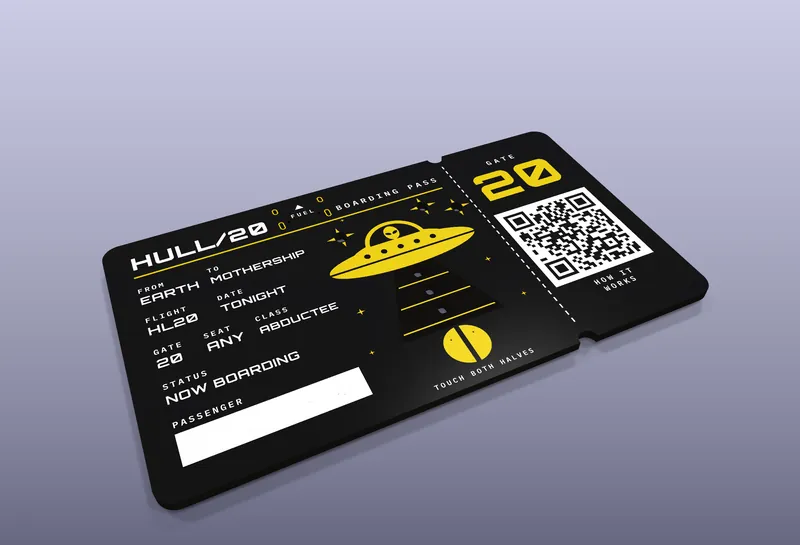
Boarding passes you can hold, for Gate 20's passengers: a circuit board cut like a ticket. Touch both halves and a Darlington pair, running on what leaks through your fingers, switches on the beam. A hundred assembled boards are on order, which makes us either a souvenir shop or a very small airline.
Saucer control from the browser. It's built; it boards with the next flash over the cable.
Cat eyes. After the season, the big light in the belly becomes one of a pair of cat eyes. It already has a pupil and a blink, so the saucer took the news well.
- Unless otherwise specified
- DIMENSIONS IN MM [IN]
BUILD RECORD: AS BUILT,
NOT FOR MANUFACTURE
DO NOT SCALE DRAWING - Drawn
- R. DIXON
- 2026-10-30
- Checked
- R. DIXON
- 2026-10-30
- Approved
- R. DIXON
- 2026-10-30
- Owner
- HULL/20
SPACEWAYS - Document type
- BUILD RECORD
- Status
- RELEASED
- Units
- —
- Projection
- THIRD ANGLE
PROJECTION - Title
- UPCOMING DEPARTURES
- Size
- B
- Scale
- NTS
- Sheet
- 16 OF 17
- Dwg no.
- HULL-20-UFO-001
- Rev
- E
XVI29 October, night
Maiden flight
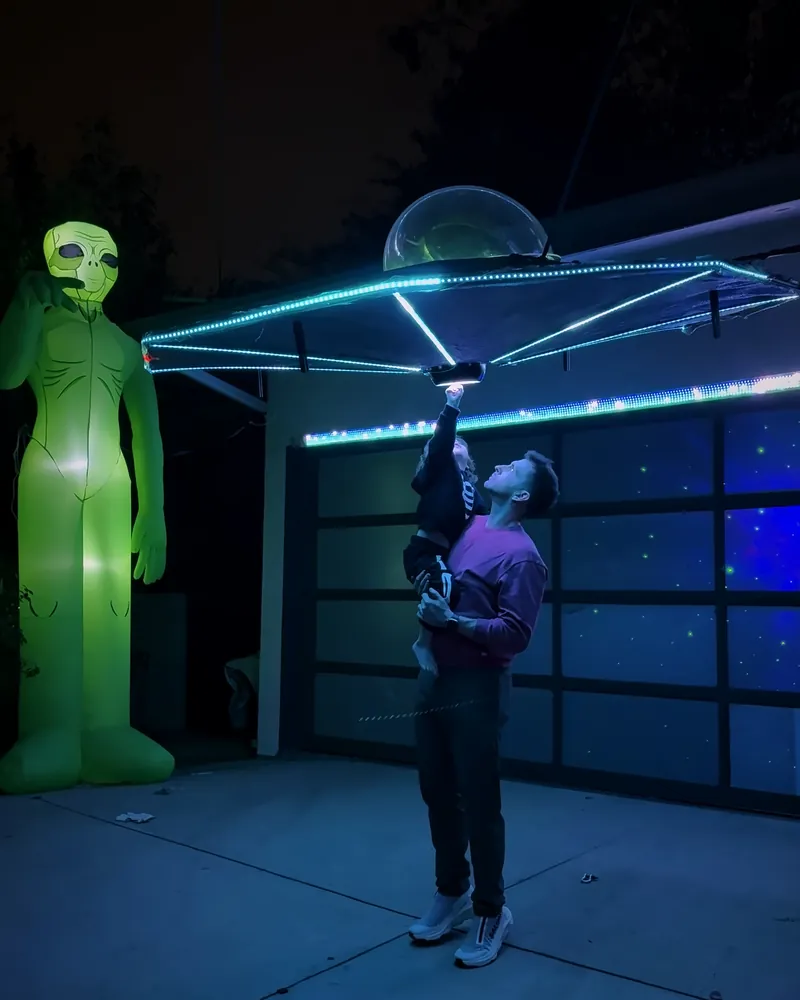
The fleet's newest ship took its maiden flight. Acid rain or shine. It hung over the garage, lit from below, with the banner and the eyes behind it, and every few minutes it abducted nobody in particular.
That night I held Linux up under the saucer and he reached up and touched it.
First contact.
He has since been abducted by the maker bug. Flight record closed. The ship is still up there.
Prefer the story? Passenger edition
- Unless otherwise specified
- DIMENSIONS IN MM [IN]
BUILD RECORD: AS BUILT,
NOT FOR MANUFACTURE
DO NOT SCALE DRAWING - Drawn
- R. DIXON
- 2026-10-29
- Checked
- LINUX
- 2026-10-29
- Approved
- R. DIXON
- 2026-10-29
- Owner
- HULL/20
SPACEWAYS - Document type
- BUILD RECORD
- Status
- RELEASED
- Units
- —
- Projection
- THIRD ANGLE
PROJECTION - Title
- MAIDEN FLIGHT
- Size
- B
- Scale
- NTS
- Sheet
- 17 OF 17
- Dwg no.
- HULL-20-UFO-001
- Rev
- E
The 2027 skin
Next year the Aluminet, the belly sail and the ¾ inch plywood plates come off. In their place go sixteen floating panels, top and belly, and aluminum plates for the 2020 frame, all cut from files a script writes. The script draws every part from the frame drawing's numbers, and the same numbers draw these sheets and the 3D model, so the three always agree.
The seams between panels are open: an 8 mm reveal, about 5⁄16 inch, with every panel edge free. It reads as deliberate, and it absorbs ±4 mm of build error at every edge. Each panel sits on three lines of the frame: the rim, the middle of its spoke, and the hub or centre plate. A top panel rests on two standoffs on the rim and one on the porthole plate, and its inner edge is clamped under the deck plate. A belly panel hangs from the rim and from a 2 inch standoff under its spoke, and its inner edge is clamped between the centre plate and the bezel. The reveals under the belly fall right under the eight LED channels, so from below it reads as eight lit lines between glowing panels.
3D model: /build/3d
Drawing HULL-20-UFO-027 sheet 1: skin, floating panels, assembly, parts list and notes
| Revisions | ||||
|---|---|---|---|---|
| Zone | Rev | Description | Date | Approved |
| ALL | A | CUT FILES: SIXTEEN FLOATING PANELS WITH AN 8 MM REVEAL; DECK, CENTRE PLATE, BEZEL, PORTHOLE PLATES | 2026-10-31 | R. DIXON |
| C6 D6 E6 | B | NOTE 6: UV-PROTECTED SHEET, OUTDOORS ALL YEAR. FIND 19 M5 × 25 (WAS × 20); FIND 18 5.6 FT (WAS 4); FIND 17 16 FT (WAS 12) | 2026-11-01 | R. DIXON |
| B6 D6 E6 | C | RIM STACK AS BOUGHT SETS SLOPE 10.59°; 3/16 PANELS AND PLATES; M5 × 30 | 2026-11-01 | R. DIXON |
| C6 D6 F6 | D | STACK INCLUDES ANGLED WASHER; SLOPE 10.26° TOP, 4.39° BELLY; MID PADS DELETED | 2026-11-01 | R. DIXON |
| Balloon | Part | Find no. |
|---|---|---|
| 1 | RIM A, 2020, TOP SLOT | DRAWING 010, A |
| 2 | T-NUT, DROP-IN, M6 | 11 |
| 3 | SCREW, M6 × 12 | 12 |
| 4 | STANDOFF, GLASS, Ø.75 × 1.00 | 9 |
| 5, 9 | WASHER, ANGLED, 10.26°, LOWER AND UPPER | 28 |
| 6, 8 | WASHER, EPDM, 3.0 | 15 |
| 7 | PANEL, TOP | 1, 2 |
| 10 | CAP, M6 (WITH THE STANDOFF) | 9 |
| Find no. | Qty reqd | Part or identifying no. | Nomenclature or description | Material or specification | Notes | Buy |
|---|---|---|---|---|---|---|
| 1 | 4 | HULL-20-UFO-027-P01 | PANEL, TOP, LIFT SPOKE, BRIDLE SLOT | POLYCARBONATE 3/16 [4.76], UV-PROTECTED | 6 7 | 4 |
| 2 | 4 | HULL-20-UFO-027-P02 | PANEL, TOP | POLYCARBONATE 3/16 [4.76], UV-PROTECTED | 6 7 | 4 |
| 3 | 4 | HULL-20-UFO-027-P03 | PANEL, BELLY, LIFT SPOKE, LEG AND PAD EYE SLOT | POLYCARBONATE 3/16 [4.76], UV-PROTECTED | 6 7 | 4 |
| 4 | 4 | HULL-20-UFO-027-P04 | PANEL, BELLY | POLYCARBONATE 3/16 [4.76], UV-PROTECTED | 6 7 | 4 |
| 5 | 1 | HULL-20-UFO-027-P05 | PLATE, DECK | AL 5052-H32 3/16 [4.76], ASTM B209 | 5 | 1 |
| 6 | 1 | HULL-20-UFO-027-P06 | PLATE, CENTRE, Ø9.50 BEAM PORT | AL 5052-H32 3/16 [4.76], ASTM B209 | 5 | 1 |
| 7 | 1 | HULL-20-UFO-027-P07 | BEZEL, BELLY | AL 5052-H32 .125, ASTM B209 | 5 | 1 |
| 8 | 8 | HULL-20-UFO-027-P08 | PLATE, PORTHOLE | AL 5052-H32 .125, ASTM B209 | 5 | 8 |
| 9 | 40 | HULL-20-UFO-027-H01 | STANDOFF, GLASS, Ø.75 × 1.00, M6 CAP | STAINLESS | 44 | |
| 10 | 8 | HULL-20-UFO-027-H02 | STANDOFF, GLASS, Ø.75 × 2.00, M6 CAP | STAINLESS | 12 | 10 |
| 11 | 40 | HULL-20-UFO-027-H03 | T-NUT, DROP-IN, M6, 2020 SLOT 6, SPRING BALL | STAINLESS | 50 | |
| 12 | 40 | HULL-20-UFO-027-H04 | SCREW, M6 × 12, HEAD TO SUIT STANDOFF BASE | A2 STAINLESS | 12 | 50 |
| 13 | AR | HULL-20-UFO-027-H05 | SCREW, M6 × 16, SAME HEAD (IF BASE IS THICKER) | A2 STAINLESS | 12 | 25 |
| 14 | 8 | HULL-20-UFO-027-H06 | SCREW, BUTTON HEAD, M6 × 20 (TOP MID) | A2 STAINLESS | 10 | |
| 15 | 96 | HULL-20-UFO-027-H07 | WASHER, 3.0 THK, M6, Ø20 TO 25 OD | EPDM | 12 | 120 |
| 16 | — | HULL-20-UFO-027-H08 | DELETED, REV D (WAS PAD, EPDM, 4.0 THK) | — | — | |
| 17 | 16 FT | HULL-20-UFO-027-H09 | STRIP, SPONGE, .50 × .125, ADHESIVE BACK | EPDM | 25 FT | |
| 18 | 5.6 FT | HULL-20-UFO-027-H10 | TRIM, U EDGE, FOR 3/16 SHEET | RUBBER | 8 | 10 FT |
| 19 | 8 | HULL-20-UFO-027-H11 | SCREW, BUTTON HEAD, M5 × 30, WITH NUT, NYLOCK, M5 | A2 STAINLESS | 10 | |
| 20 | 16 | HULL-20-UFO-027-H12 | WASHER, FLAT, M5 | A2 STAINLESS | 20 | |
| 21 | 8 | HULL-20-UFO-027-H13 | SCREW, BUTTON HEAD, M6 × 50 (J5), REUSE | STAINLESS | — | |
| 22 | 8 | HULL-20-UFO-027-H14 | SCREW, BUTTON HEAD, M6 × 20 (DOME LIP) | A2 STAINLESS | 10 | |
| 23 | 8 | HULL-20-UFO-027-H15 | WASHER, FENDER, M6, Ø1.00 OD | STAINLESS | 10 | |
| 24 | 8 | HULL-20-UFO-027-H16 | WASHER, FLAT, M6, WITH NUT, NYLOCK, M6 | STAINLESS | 10 | |
| 25 | 1 | HULL-20-UFO-027-H17 | GROMMET, Ø1.50 HOLE, .125 PANEL | RUBBER | 2 | |
| 26 | 4 | HULL-20-UFO-027-H18 | SCREW, BUTTON HEAD, M6 × 16, WITH WASHER | A2 STAINLESS | 6 | |
| 27 | AR | HULL-20-UFO-027-H19 | DISC, SANDING, Ø5, 220 AND 320 GRIT, OR FILM, FROSTED | — | 7 | 25 EA |
| 28 | 96 | HULL-20-UFO-027-H20 | WASHER, ANGLED, Ø25, M6 CLEARANCE, 2.0 THIN EDGE: 10.26° TOP × 48, 4.39° BELLY × 48; 8 TOP MID +0.6 THICK | ASA, PRINTED | 12 | 104 |
| 29 | AR | HULL-20-UFO-027-H21 | THREADLOCKER, MEDIUM STRENGTH | — | 11 | — |
Notes
Unless otherwise specified:
- Dimensions are in millimetres [inches]. Tolerances: X.X ±0.25 [.XX ±.01], X.XX ±0.13 [.XXX ±.005], angles ±0.5°. Dimensioning and tolerancing per ASME Y14.5.
- Profiles per the cut files (*.dxf), 1:1 in inches, one part per file. The cut file governs the profile.
- Break sharp edges 0.25 [.010] max. Deburr all holes.
- Aluminum parts: 5052-H32 per ASTM B209. Find 5, 6: 3/16 [4.76] thk. Find 7, 8: .125 [3.2] thk.
- Finish, aluminum: black powder coat, mask holes. Find 5 is over 23 in: powder coat, not anodize.
- Polycarbonate parts, find 1 to 4: 3/16 [4.76] thk, UV-protected grade, coated face out; cast acrylic acceptable. Leave the protective film on until install.
- Frost the inner face only (underside of find 1, 2; upper face of find 3, 4): wet-sand 220 then 320 grit, or frosted film. Gloss face out.
- Panel holes Ø.394 [10] for M6, clearance for thermal movement. Line the slots with U edge trim, find 18.
- Reveal between panels .31 [8], absorbs ±.16 [4] build error at each edge.
- If a 36.6 in belly panel exceeds the cutting bed, split each belly facet on its centre line (16-panel belly).
- M6 into T-nuts and tapped posts: medium-strength threadlocker, find 29.
- Stack as built: standoff barrel 25.4 [1.00], printed angled washer (find 28) 4.26 [.168] at the axis, EPDM washer 3.0 [.12]: 32.66 [1.286] from the rim to the panel underside, which sets the top slope 10.26°. Belly stack 31.36 [1.235], slope 4.39°. An angled washer goes on each side of the panel at every standoff; the 8 top mid-support washers print 0.6 thicker. Test-fit one standoff before ordering the rest. See section A-A, sheet 4.
- Unless otherwise specified
- DIMENSIONS IN MM [IN]
TOLERANCES: X.X ±0.25 X.XX ±0.13
ANGLES ±0.5° BREAK EDGES 0.25
DO NOT SCALE DRAWING - Drawn
- R. DIXON
- 2026-11-01
- Checked
- R. DIXON
- 2026-11-01
- Approved
- R. DIXON
- 2026-11-01
- Owner
- HULL/20
SPACEWAYS - Document type
- ASSEMBLY DRAWING
- Status
- IN WORK
- Units
- MM [IN]
- Projection
- THIRD ANGLE
PROJECTION - Title
- SKIN, FLOATING PANELS, 2027
- Size
- B
- Scale
- AS SHOWN
- Sheet
- 1 OF 4
- Dwg no.
- HULL-20-UFO-027
- Rev
- D
Drawing HULL-20-UFO-027 sheet 2: cut parts
- Unless otherwise specified
- DIMENSIONS IN MM [IN]
TOLERANCES: X.X ±0.25 X.XX ±0.13
ANGLES ±0.5° BREAK EDGES 0.25
DO NOT SCALE DRAWING - Drawn
- R. DIXON
- 2026-11-01
- Checked
- R. DIXON
- 2026-11-01
- Approved
- R. DIXON
- 2026-11-01
- Owner
- HULL/20
SPACEWAYS - Document type
- DETAIL DRAWING
- Status
- IN WORK
- Units
- MM [IN]
- Projection
- THIRD ANGLE
PROJECTION - Title
- SKIN, CUT PARTS
- Size
- B
- Scale
- 1:12
- Sheet
- 2 OF 4
- Dwg no.
- HULL-20-UFO-027
- Rev
- D
Drawing HULL-20-UFO-027 sheet 3: deck plate, find 5
| Tag | X | Y | [X] | [Y] | Size | Description |
|---|---|---|---|---|---|---|
| A1 | +372.10 | 0.00 | [+14.650] | [0.000] | Ø6.6 [.260] | J5 DECK + HUB RING TO E POST |
| A2 | +263.11 | +263.11 | [+10.359] | [+10.359] | Ø6.6 [.260] | J5 DECK + HUB RING TO E POST |
| A3 | 0.00 | +372.10 | [0.000] | [+14.650] | Ø6.6 [.260] | J5 DECK + HUB RING TO E POST |
| A4 | -263.11 | +263.11 | [-10.359] | [+10.359] | Ø6.6 [.260] | J5 DECK + HUB RING TO E POST |
| A5 | -372.10 | 0.00 | [-14.650] | [0.000] | Ø6.6 [.260] | J5 DECK + HUB RING TO E POST |
| A6 | -263.11 | -263.11 | [-10.359] | [-10.359] | Ø6.6 [.260] | J5 DECK + HUB RING TO E POST |
| A7 | 0.00 | -372.10 | [0.000] | [-14.650] | Ø6.6 [.260] | J5 DECK + HUB RING TO E POST |
| A8 | +263.11 | -263.11 | [+10.359] | [-10.359] | Ø6.6 [.260] | J5 DECK + HUB RING TO E POST |
| B1 | +293.56 | +121.60 | [+11.558] | [+4.787] | Ø6.6 [.260] | DOME LIP |
| B2 | +121.60 | +293.56 | [+4.787] | [+11.558] | Ø6.6 [.260] | DOME LIP |
| B3 | -121.60 | +293.56 | [-4.787] | [+11.558] | Ø6.6 [.260] | DOME LIP |
| B4 | -293.56 | +121.60 | [-11.558] | [+4.787] | Ø6.6 [.260] | DOME LIP |
| B5 | -293.56 | -121.60 | [-11.558] | [-4.787] | Ø6.6 [.260] | DOME LIP |
| B6 | -121.60 | -293.56 | [-4.787] | [-11.558] | Ø6.6 [.260] | DOME LIP |
| B7 | +121.60 | -293.56 | [+4.787] | [-11.558] | Ø6.6 [.260] | DOME LIP |
| B8 | +293.56 | -121.60 | [+11.558] | [-4.787] | Ø6.6 [.260] | DOME LIP |
| C1 | 0.00 | 0.00 | [0.000] | [0.000] | Ø38.1 [1.500] | CABLE PASS |
- Unless otherwise specified
- DIMENSIONS IN MM [IN]
TOLERANCES: X.X ±0.25 X.XX ±0.13
ANGLES ±0.5° BREAK EDGES 0.25
DO NOT SCALE DRAWING - Drawn
- R. DIXON
- 2026-11-01
- Checked
- R. DIXON
- 2026-11-01
- Approved
- R. DIXON
- 2026-11-01
- Owner
- HULL/20
SPACEWAYS - Document type
- DETAIL DRAWING
- Status
- IN WORK
- Units
- MM [IN]
- Projection
- THIRD ANGLE
PROJECTION - Title
- PLATE, DECK
- Size
- B
- Scale
- 1:5
- Sheet
- 3 OF 4
- Dwg no.
- HULL-20-UFO-027
- Rev
- D
Drawing HULL-20-UFO-027 sheet 4: sections and details
Measure the ship before ordering
The cut files follow the frame drawing. The plates went on in ¾ in ply, so check these against the frame as built:
- Hub ring, outside across flats: about 30⅛ in (765 mm). This is the deck size.
- Hub ring top above the rim top: about 6⅜ in (162 mm). This sets the top panels' slope.
- Rim side, outside: about 36.1 in (916.6 mm).
- Centre plate underside below the rim top: the F legs (90 mm) under the core ring, plus the plate. This sets the belly slope.
- Centre plate leg holes: 4 on a 7⅛ in (181 mm) radius, each 1.57 in to one side of a flat's centre line, all to the same side. Lay the old plate over the print.
- Dome lip bolts: 8 × M6 on a 25 in circle between the spokes, through the lip into the deck. No G riser posts were built: the dome sits on the deck. Cable hole Ø1½ in, central.
- Lift pad eyes 1000 mm from centre; leg posts 940 mm, on the same 4 spokes.
- Porthole posts K: 744 mm from centre, 60 mm tall.
- Belly LED channels must sit above the belly panels. If a channel hangs lower than the panel at mid-span, the belly standoffs go to 1½ in and 2½ in.
- The 2020 profile, drop-in T-nut and standoff internals in the sections are generic: check them against the hardware in hand.
- Unless otherwise specified
- DIMENSIONS IN MM [IN]
TOLERANCES: X.X ±0.25 X.XX ±0.13
ANGLES ±0.5° BREAK EDGES 0.25
DO NOT SCALE DRAWING - Drawn
- R. DIXON
- 2026-11-01
- Checked
- R. DIXON
- 2026-11-01
- Approved
- R. DIXON
- 2026-11-01
- Owner
- HULL/20
SPACEWAYS - Document type
- DETAIL DRAWING
- Status
- IN WORK
- Units
- MM [IN]
- Projection
- THIRD ANGLE
PROJECTION - Title
- SECTIONS AND DETAILS, SKIN 2027
- Size
- B
- Scale
- AS SHOWN
- Sheet
- 4 OF 4
- Dwg no.
- HULL-20-UFO-027
- Rev
- D